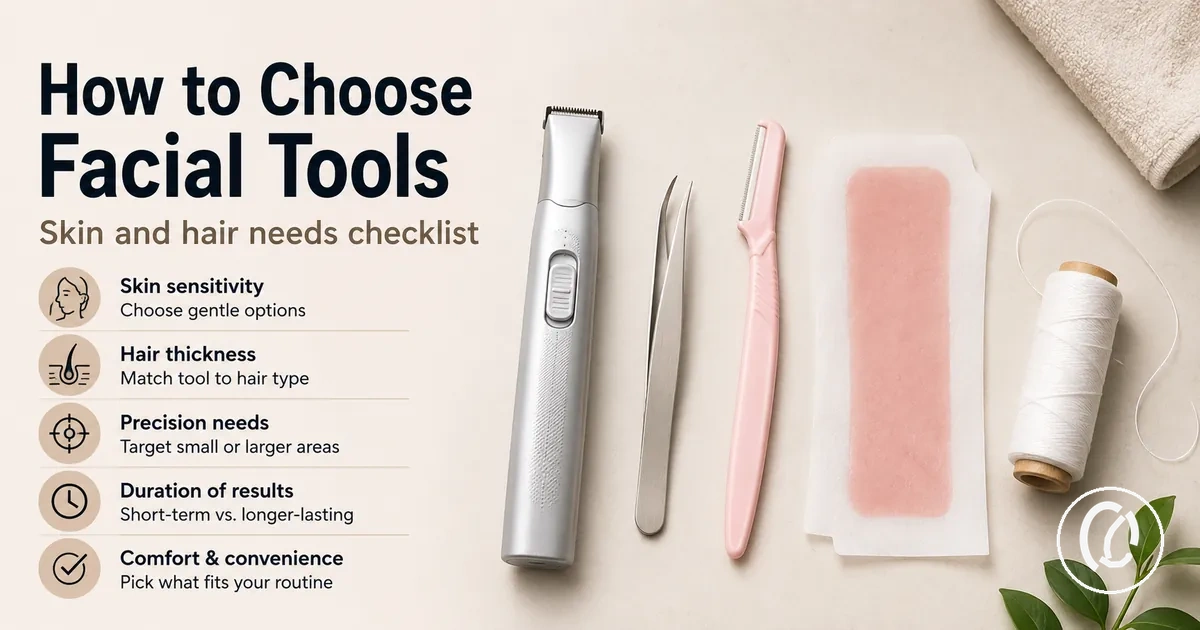
Facial Hair Removal Tool Selection Criteria
A facial hair removal tool should be selected by matching its function to the user need, skin tolerance, hair texture, facial area, and practical features. The correct fit is conditional rather than universal: a tool is suitable only when its contact method, precision, comfort limits, and upkeep requirements match the intended use.
A facial hair removal tool should be selected by matching its function to the user need, skin tolerance, hair texture, facial area, and practical features.
For quick touch-ups, convenience and portability carry more weight; for routine grooming, repeated-use comfort and irritation risk matter more; for upper-lip, chin, or cheek work, facial area and precision become the main filters. Fine hair and peach fuzz require a different contact approach from coarse hair, while blade design, head shape, rechargeability, cleaning, and replacement needs determine whether the grooming tool remains practical over time.
Use these top-level selection criteria before comparing individual options:
- Removal need: Choose between touch-up use, routine grooming, or precision-focused removal.
- Skin tolerance: Match pressure, friction, and contact method to your irritation history and comfort limit.
- Hair texture: Distinguish fine hair, peach fuzz, and coarse hair because each condition requires a different balance of contact, grip, and cutting efficiency.
- Facial area: Prioritise precision for the upper lip and chin, and broader control for the cheeks or jawline.
- Features: Compare blade type, head design, rechargeability, handling, and visibility aids according to the intended use.
- Upkeep: Check the required cleaning method, replacement-part needs, and storage routine before treating the facial hair remover as a practical fit.
Table of Contents
Facial Hair Removal Tool Fit Starts With the Removal Need
A facial hair removal tool should be selected by identifying your removal need before comparing features or products. The first filter is whether your goal is quick touch-ups, routine grooming, or precision work on a small facial area because each use case requires a different balance of convenience, control, and comfort. The main removal need is the starting point for deciding overall suitability.
The main removal need is the starting point for deciding overall suitability.
A person who wants quick touch-ups during the day will usually benefit from prioritising convenience and portability, while someone performing routine grooming should give greater weight to comfort during repeated use. If the goal is precise removal on the upper lip or chin, accurate control becomes more important than speed. Before comparing individual facial hair removal tools, match the removal need with your skin tolerance, hair texture, and facial area so the later feature comparisons reflect your intended use rather than a generic product comparison.
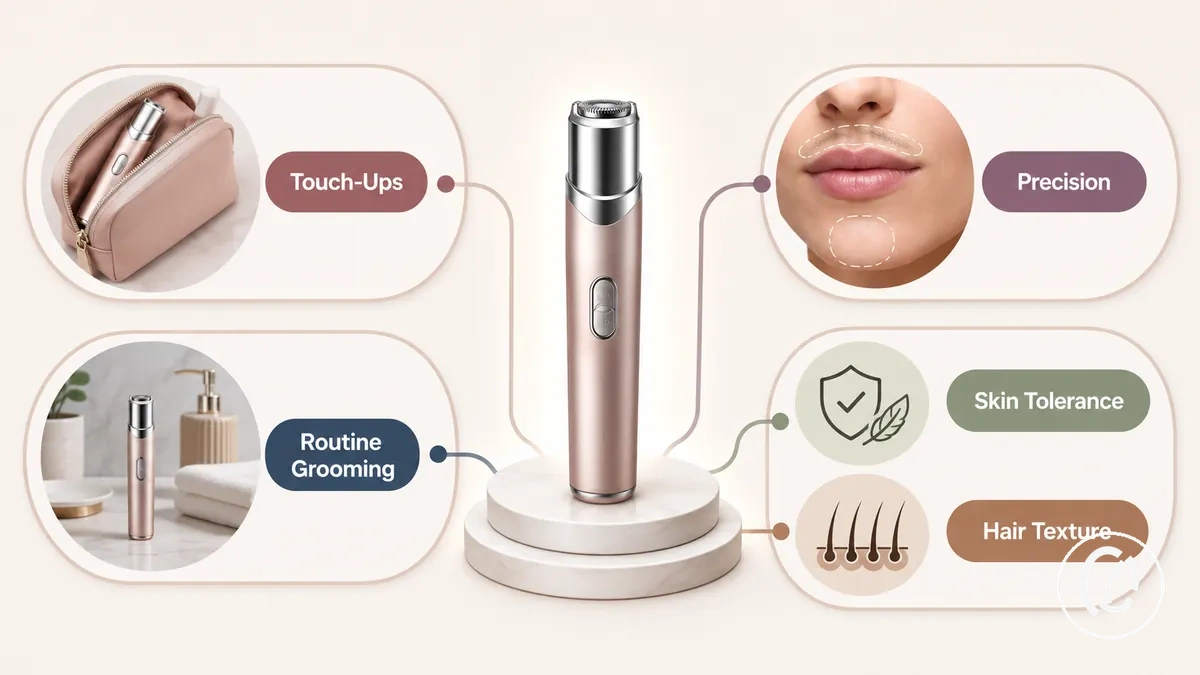
Facial Hair Removal Tool Fit Starts With the Removal Need is easiest to apply when one primary use case guides the rest of the selection process. The checklist below organises the first decision before you evaluate detailed features.
- Convenience-led need: Choose this path when quick touch-ups and portability are the main priority.
- Comfort-led need: Choose this path when routine grooming requires repeated use with suitable skin tolerance.
- Precision-led need: Choose this path when removing hair from small facial areas such as the upper lip or chin.
- Hair-texture-led need: Match the facial hair removal tool to fine hair, peach fuzz, or coarse facial hair before comparing additional features.
- Suitability check: Confirm that the removal need also aligns with your skin tolerance and facial area before moving to detailed selection criteria.
Skin Type and Sensitivity Criteria
Skin type and skin tolerance should be the first criteria for filtering a facial hair removal tool before any comfort claim is trusted because suitability depends on your history of skin reactions, the amount of blade or ingredient contact, the pressure required during use, and your after-use reaction. Sensitive skin requires qualified selection rather than assuming any facial hair removal tool is painless, hypoallergenic, or suitable for every user.
Skin Type and Sensitivity Criteria helps organise tolerance, contact, and reaction checks before comparing individual tools.
Skin Type and Sensitivity Criteria helps organise tolerance, contact, and reaction checks before comparing individual tools.
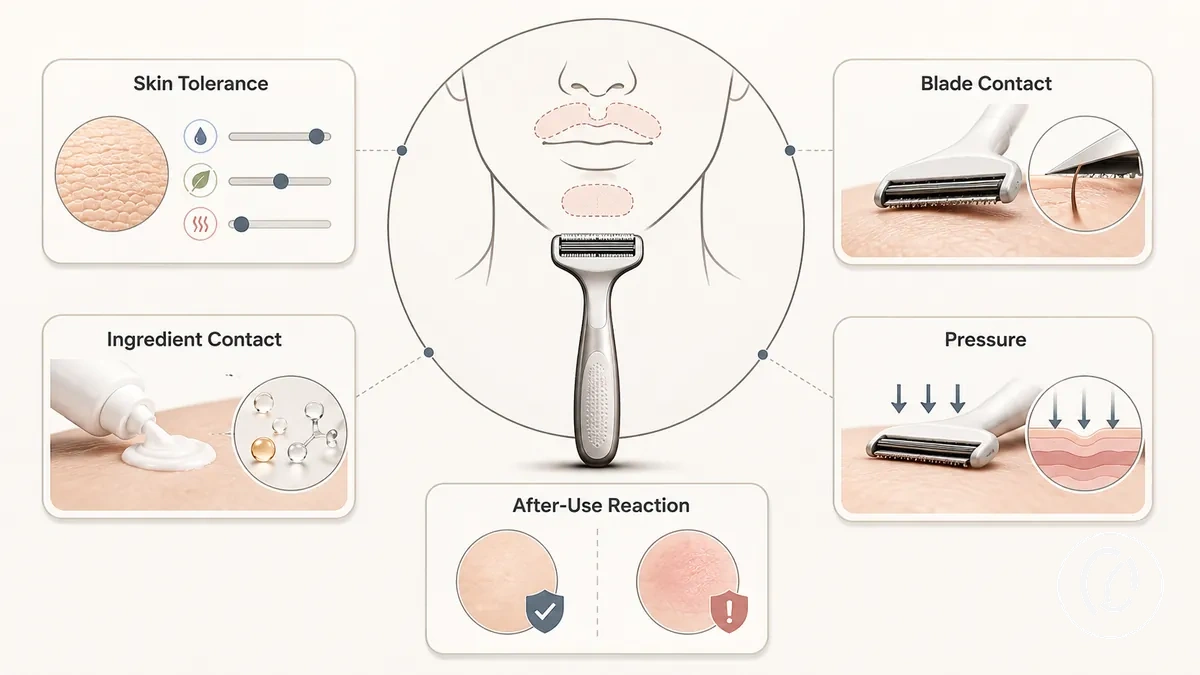
If you have an irritation history, begin by identifying whether the facial hair removal method uses direct blade contact or involves ingredient contact such as depilatory creams because each creates a different source of skin stress. According to the International Forum for the Study of Itch, sensitive skin is characterised by unpleasant sensations such as stinging, burning, pain, pruritus, or tingling triggered by stimuli that normally should not produce these sensations, while visible redness may or may not be present. Evaluate the amount of pressure needed to remove hair and monitor the after-use reaction, including persistent redness or stinging, because these observations provide more reliable suitability checks than broad comfort claims. For example, if two tools remove the same amount of facial hair but one requires repeated passes with greater pressure while the other removes hair in a single light pass, the lower-contact option is generally the more appropriate starting point for reactive skin.
Comfort claims should be interpreted cautiously because they do not predict how every person's skin will respond under the same conditions.
Comfort claims should be interpreted cautiously because they do not predict how every person's skin will respond under the same conditions. If your skin frequently becomes red, stings, or feels uncomfortable after grooming, choose for sensitive skin by prioritising lower-contact designs and reassessing suitability after each use rather than relying on marketing descriptions.
| Criterion | What to check | Why it matters | Selection caution |
|---|---|---|---|
| Skin tolerance | Previous redness, stinging, or irritation | Shows how your skin has responded to hair removal | Do not treat comfort claims as proof of suitability |
| Blade contact | Amount of direct skin contact and repeated passes | More friction can increase irritation risk | Avoid unnecessary repeated strokes over the same area |
| Ingredient contact | Creams, gels, or chemical hair-removal products touching the skin | Ingredients may trigger a skin response in sensitive users | Review ingredients before first use |
| Pressure | Force needed for effective hair removal | Greater pressure generally increases skin friction | Reduce pressure if discomfort develops during use |
| After-use reaction | Persistent redness, stinging, or discomfort | Provides practical evidence of ongoing suitability | Stop using the method if irritation continues or worsens |
Hair Texture and Growth Pattern Fit
Hair texture and growth pattern determine facial hair removal tool compatibility because fine hair, peach fuzz, coarse hair, short regrowth, and stubborn hair require different cutting characteristics, visibility, and skin contact. No facial hair removal tool is equally suitable for every facial hair condition, so hair texture changes tool suitability and limitation rather than changing the hair itself.
The comparison below focuses on compatibility criteria rather than removal results.
Hair Texture and Growth Pattern Fit compares how each facial hair condition influences tool compatibility before individual products are evaluated. The comparison below focuses on compatibility criteria rather than removal results.
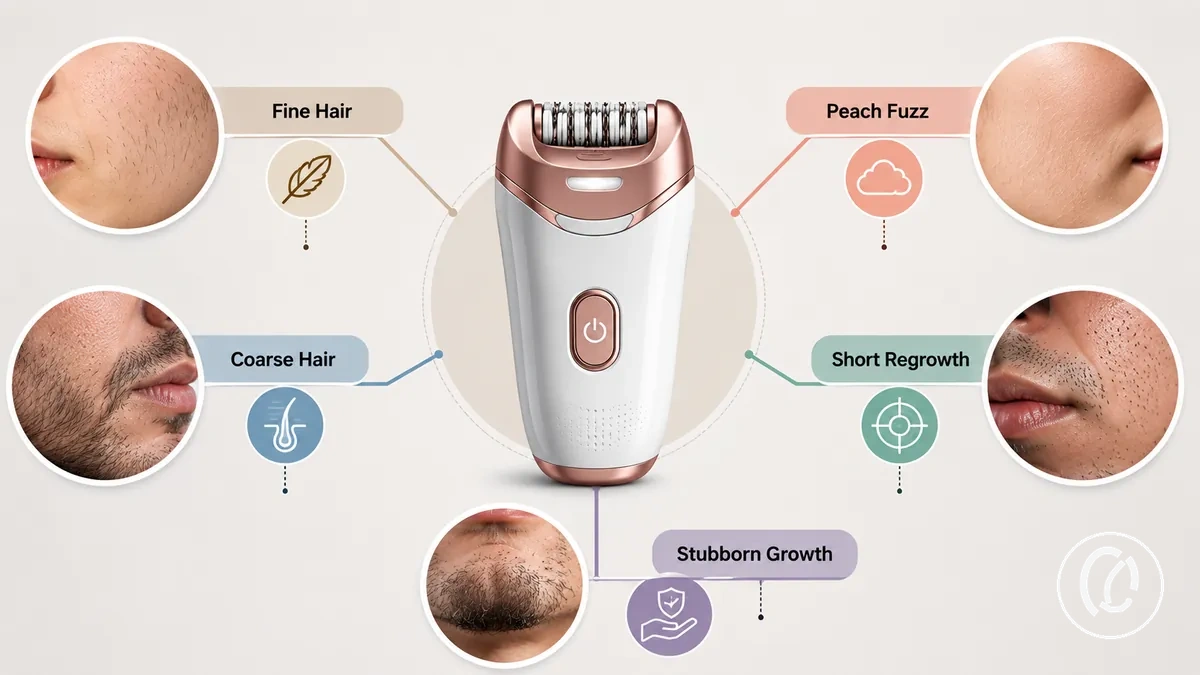
If two people use the same facial hair removal tool, the person removing peach fuzz may achieve even surface removal with light contact, while another removing coarse chin hair may require slower, repeated passes because thicker strands create different cutting resistance. Likewise, short regrowth often requires greater visibility and positioning accuracy than longer visible growth because very short hairs can be harder to identify on the skin surface. Surface hair removal does not make facial hair thicker; the American Academy of Dermatology states that shaving changes only the cut end of the hair, not its thickness or growth rate. Use the comparison below to identify the main compatibility requirement before you choose by hair texture.
| Hair condition | Tool-fit concern | Useful attribute | Limitation to qualify |
|---|---|---|---|
| Fine hair | Capturing thin strands consistently | Light-contact cutting and precise control | Fine hairs can be missed if visibility is limited |
| Peach fuzz | Removing soft surface hair evenly | Close surface contact across broad facial areas | Surface removal does not change future hair thickness |
| Coarse hair | Cutting thicker facial hair comfortably | Stable grip and repeated-use tolerance | Repeated passes may increase irritation risk on sensitive skin |
| Short regrowth | Capturing very short visible hairs | High visibility and accurate positioning | Very short hairs may require slower, more controlled movements |
| Stubborn chin growth | Managing dense or resistant facial hair patches | Consistent cutting contact with controlled handling | No single facial hair removal tool is suitable for every growth pattern |
Fine Hair and Peach Fuzz
Fine hair and peach fuzz are best matched with facial hair removal tools that prioritise light contact, precision, and clear visibility because these hairs are thin, have short surface length, and sit close to the skin. According to the Cleveland Clinic, peach fuzz is vellus hair, a fine, soft hair type that covers much of the face and body, making controlled surface cutting more appropriate than forceful contact. For this local compatibility decision, light contact and precision are the primary selection priorities. :contentReference[oaicite:0]{index=0}
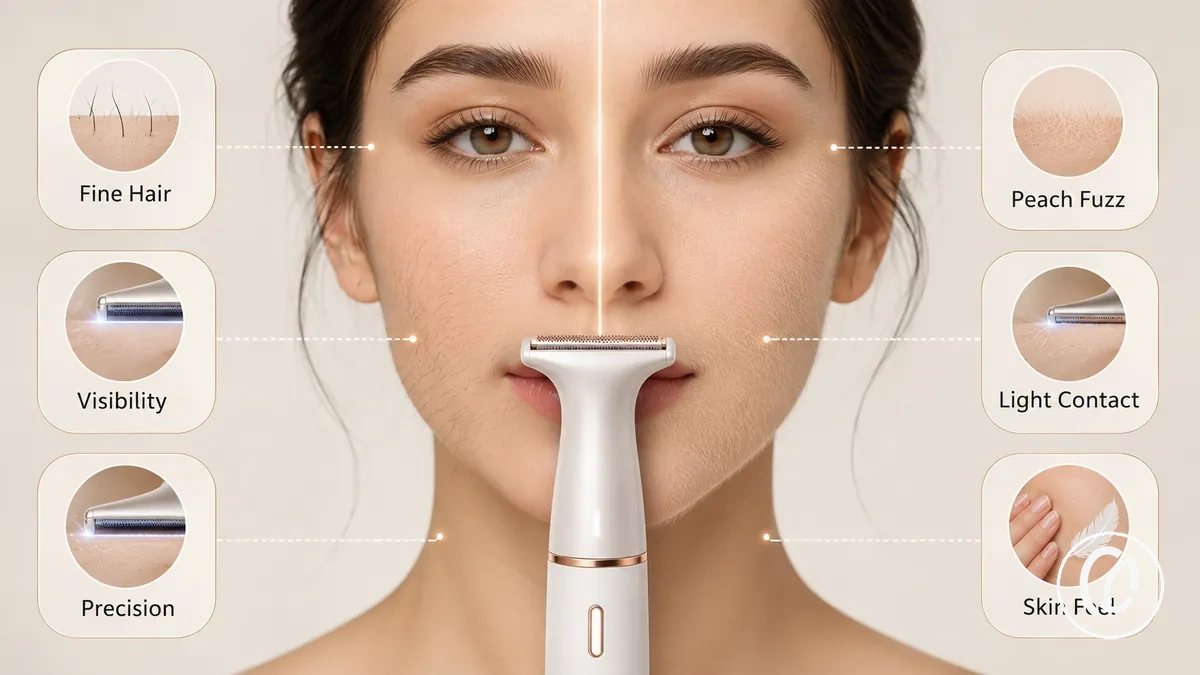
Fine Hair and Peach Fuzz selection is mainly influenced by four local compatibility factors that affect visibility, skin feel, and contact with the skin surface.
- Visibility: Fine hair is often difficult to distinguish from the surrounding skin, so precise positioning helps remove visible hairs without unnecessary repeated passes.
- Density: Peach fuzz commonly forms a uniform layer of soft facial hair, making even light-contact coverage more suitable than increased pressure.
- Surface length: Because vellus hair has a short surface length, precise cutting close to the skin can improve skin feel while limiting unnecessary skin contact.
- Abrasion risk: If repeated strokes or excessive pressure are applied, abrasion risk increases, so gentle contact and precision remain the preferred compatibility approach for fine facial hair and peach fuzz.
Coarse Chin Hair and Stubborn Growth
Coarse chin hair and stubborn growth are most compatible with facial hair removal tools that provide sufficient grip, consistent cutting efficiency, and comfortable repeated-use tolerance because thicker terminal hairs create greater cutting resistance and increased regrowth visibility. According to the Cleveland Clinic, terminal hair is thicker, darker, and coarser than vellus hair, making controlled cutting performance and stable handling more important than for fine facial hair. For coarse chin hair, the key compatibility trade-off is achieving enough grip for efficient cutting without increasing unnecessary skin irritation. :contentReference[oaicite:0]{index=0}
For coarse chin hair, the key compatibility trade-off is achieving enough grip for efficient cutting without increasing unnecessary skin irritation.
When coarse chin hair requires repeated grooming, prioritise cutting efficiency before increasing pressure because repeated passes increase skin contact and can increase irritation risk. For example, if one controlled pass leaves visible coarse hairs, a second light pass is generally preferable to applying greater force during the first pass because it reduces unnecessary friction while maintaining control. If stubborn growth becomes persistent, changes noticeably, or appears unusual for you, product selection alone may not explain the pattern and advice beyond product selection may be appropriate. :contentReference[oaicite:1]{index=1}
When coarse chin hair requires repeated grooming, prioritise cutting efficiency before increasing pressure because repeated passes increase skin contact and can increase irritation risk.
Coarse Chin Hair and Stubborn Growth requires attention to these local compatibility cautions:
- Irritation risk: Repeated passes increase skin contact, so rely on controlled handling rather than excessive pressure to improve cutting efficiency.
- Repeated-use tolerance: If frequent grooming is necessary, choose a facial hair removal tool that remains comfortable over repeated sessions instead of depending on additional force.
- Persistent growth: If coarse chin hair changes substantially or remains unusually persistent despite appropriate grooming, consider seeking advice beyond product selection rather than expecting consumer facial hair removal tools to address the underlying cause.
Facial Area and Precision Requirements
Facial area determines the precision requirements for a facial hair removal tool because surface size, contour, visibility, and sensitivity change the level of control needed during hair removal. Small treatment areas such as the upper lip and parts of the chin generally require more precise positioning than broader areas such as the cheeks and jawline, where maintaining consistent surface coverage becomes the primary compatibility criterion. Area shape and surface size therefore change the control requirements for an appropriate facial hair removal tool. :contentReference[oaicite:0]{index=0}
Area shape and surface size therefore change the control requirements for an appropriate facial hair removal tool.
If you are removing visible hair from a narrow upper-lip area, a compact tool head, stable grip, and clear visibility help you follow a small contour with fewer unnecessary repeated passes than a broader treatment area. By comparison, the cheeks and jawline provide a larger working surface where maintaining even movement across the facial area becomes more important than maximum positioning accuracy at a single point. Facial Area and Precision Requirements organise these compatibility criteria so each treatment area is matched with the level of control it requires before moving to more detailed area-specific guidance. :contentReference[oaicite:1]{index=1}
| Facial area | Precision need | Tool attribute to check | Selection caution |
|---|---|---|---|
| Upper lip | Precise positioning across a small surface with defined contours | Compact head shape, good visibility, stable grip | Repeated passes on a sensitive area can increase irritation risk |
| Chin | Controlled movement around changing contours | Grip, cutting control, head stability | Coarse hair may require additional controlled passes rather than increased pressure |
| Cheeks | Even control across a larger surface area | Consistent surface contact and comfortable handling | Avoid overlapping strokes that increase unnecessary skin contact |
| Jawline | Balanced control while following a curved contour | Head shape that follows facial contours with a secure grip | Curved edges benefit from slower positioning to maintain consistent contact |
For more detailed treatment-area guidance, choose by facial area.
Upper Lip and Chin Control
Upper lip and chin areas require greater control than broader facial areas because their smaller treatment surface, changing contour, and reduced visibility demand accurate positioning and careful pressure during facial hair removal. Facial hair removal tool compatibility is therefore determined by matching head size, angle access, grip stability, and visibility to the treatment area instead of assuming one small-area tool is suitable for every chin-hair texture. :contentReference[oaicite:0]{index=0}
Upper Lip and Chin Control is guided by the following local compatibility cues:
- Head size: A compact tool head provides better control around the upper lip, where the narrow contour requires accurate positioning.
- Angle access: The curved chin benefits from controlled access at different angles so contact follows the facial contour without relying on increased pressure.
- Grip stability: A stable grip helps maintain controlled movement, particularly when coarse chin hair requires additional carefully guided passes.
- Visibility: Clear visibility of individual hairs on the upper lip and chin helps reduce unnecessary repeated passes and supports more controlled contact.
Cheeks, Jawline, and Larger Surface Areas
Cheeks, jawline, and other larger surface areas are best matched with facial hair removal tools that support even surface coverage, reliable contour following, and smooth movement across changing facial angles. Broader skin exposure makes unnecessary repeated passes a relevant selection limitation, while jawline angle changes require enough control to maintain consistent contact. The local priority is balanced coverage and control rather than maximum speed. :contentReference[oaicite:0]{index=0}
The local priority is balanced coverage and control rather than maximum speed.
Cheeks, Jawline, and Larger Surface Areas should be assessed through these surface-handling checks:
- Surface coverage: Cheeks benefit from stable contact that moves evenly across a broad area without concentrating pressure at one point.
- Contour following: The jawline requires a head shape and grip that can follow angle changes while maintaining controlled contact.
- Skin exposure: Smooth movement may reduce unnecessary repeated passes, but speed should remain limited by skin tolerance and the control available on each contour.
Tool Type Trade-Offs for Short-Term Facial Hair Removal
Each tool type for short-term facial hair removal creates a different trade-off across contact method, removal depth, comfort profile, precision, and upkeep. Surface-cutting methods remove hair at skin level, root-removal methods pull hair from the follicle, and cream-based methods weaken exposed hair chemically. The resulting advantages and limitations are short-term and criteria-dependent rather than evidence that one removal path is universally preferable. :contentReference[oaicite:0]{index=0}
The comparison below organises each option type by its contact method, practical trade-off, best-fit condition, and limitation.
A quick touch-up may favour surface cutting because it offers broad coverage and controllable precision, while isolated visible hairs may favour root removal because individual hairs can be targeted more closely. The American Academy of Dermatology identifies shaving, tweezing, threading, waxing, and depilatories as distinct removal methods, and explains that depilatories dissolve unwanted hair while root-removal methods pull hair out. Cleveland Clinic further reports that depilatory creams destabilise hair without consistently removing it from the root, so their removal depth and regrowth profile fall between shaving and root-level methods. The comparison below organises each option type by its contact method, practical trade-off, best-fit condition, and limitation. :contentReference[oaicite:1]{index=1}
| Option type | Contact method | Trade-off | Best-fit condition | Limitation to qualify |
|---|---|---|---|---|
| Surface-cutting tool | A manual blade or powered cutting head trims hair at skin level | Fast surface coverage and adjustable precision, with the shallowest removal depth | Quick touch-ups or routine removal where speed and control matter more than delaying visible regrowth | Visible regrowth generally returns sooner than after root removal, and the blade or cutting head requires cleaning and replacement according to its instructions |
| Single-hair root remover | Tweezers grip and pull one visible hair from the follicle | Pinpoint precision and root-level removal, balanced against slow coverage and a sharper comfort profile | Isolated hairs in a clearly visible, small facial area | Low coverage efficiency makes the method impractical for dense or broad areas, and repeated plucking can irritate susceptible skin |
| Multi-hair root remover | An epilating, threading, or waxing action removes multiple hairs from the follicle | Broader root-level removal than tweezing, with less pinpoint control and a potentially less comfortable contact method | Areas where delaying visible regrowth matters more than rapid, low-contact touch-ups | Comfort and precision depend on skin tolerance, facial contour, hair accessibility, and the specific method used |
| Cream-based remover | A depilatory cream, lotion, or gel weakens exposed hair before it is wiped away | Broad coverage without blade contact, balanced against ingredient exposure and a timed application process | Users who prefer wipe-away removal and have confirmed that the formula is labelled for the intended facial area | The product requires exact adherence to its contact-time instructions and a skin-reaction check before wider use; removal depth is not consistently root-level |
Features That Matter Before Buying
The features that should influence facial hair remover selection are those that directly improve essential fit for the intended facial area, hair texture, and contact method. Head design, guard, and blade configuration have primary decision value when they affect control or cutting contact, while LED light, rechargeability, and portability are mainly convenience features unless they solve a defined visibility, power, or travel need. Feature quantity alone does not establish suitability. :contentReference[oaicite:0]{index=0}
Feature quantity alone does not establish suitability.
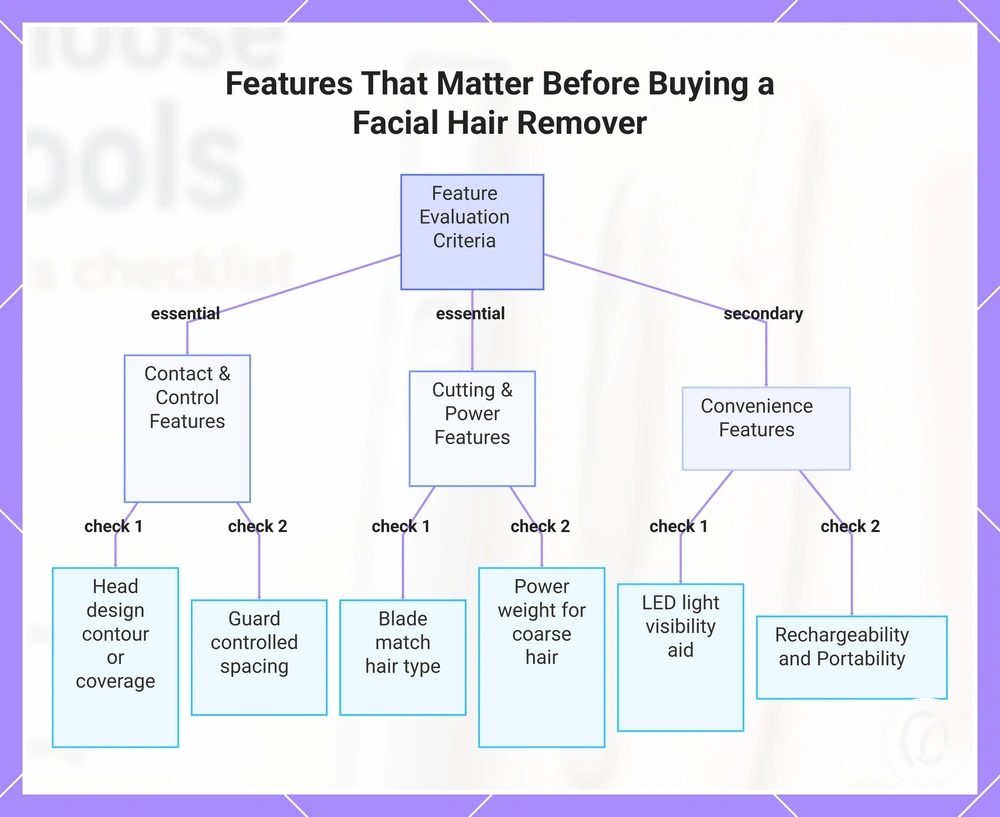
A feature becomes useful only when its attribute matches a user criterion: a compact head can support narrow-area control, whereas a broader head can support surface coverage, and neither design is preferable outside that condition. Extra power has limited decision value when the blade or contact design does not match the hair, while an LED light improves visibility rather than removal performance itself. Features That Matter Before Buying should therefore be checked by the condition each feature addresses and the decision consequence it creates. The checklist below separates essential-fit attributes from secondary convenience features.
- Head design: Treat it as essential fit when facial contour or surface size requires either precise positioning or broader coverage; reject a design that obstructs control in the intended area.
- Guard: Prioritise a guard when controlled contact or consistent spacing from the skin is part of the method; treat it as secondary when the tool does not use guarded cutting.
- Blade: Check whether the blade arrangement matches fine surface hair, coarse visible hair, or precision work; include cleaning and replacement requirements in the same decision.
- Power: Give power greater weight when dense or coarse hair requires consistent cutting action; do not treat a higher power claim as proof of comfort, precision, or suitability.
- LED light: Value an LED light when fine hair, shadow, or facial contour reduces visibility; classify it as a convenience feature when the treatment area is already clearly visible.
- Rechargeability: Prioritise rechargeability when frequent use makes disposable-battery replacement inconvenient; verify the charging method and expected access to power rather than assuming it improves removal quality.
- Portability: Treat portability as valuable for travel or quick touch-ups where compact storage matters; keep it secondary when handling stability, home use, and upkeep are the stronger criteria.
This chart shows how to separate essential-fit attributes from secondary convenience features when selecting a facial hair remover.
Blade, Head, and Guard Design
Blade, head design, and guard configuration affect a facial hair removal tool by changing the cutting surface, head size, edge exposure, and level of skin contact. A compact tool head supports more precise positioning on narrow facial contours, while a broader cutting surface supports wider coverage when stable contact is possible; neither design guarantees comfort or a lower pass count in every condition. Component design should therefore be judged by how it balances contact, control, and irritation risk for the intended area and hair texture. :contentReference[oaicite:0]{index=0}
Component design should therefore be judged by how it balances contact, control , and irritation risk for the intended area and hair texture.
Blade, Head, and Guard Design can be checked through these component-level contact cues:
- Blade: The blade arrangement should match the target hair and facial area because an unsuitable cutting surface can reduce control or require additional passes.
- Head design: A compact head supports precise positioning on small contours, while a broader head supports wider coverage where the area permits stable contact.
- Guard: A protective guard can limit direct edge contact when guarded cutting is part of the design, but it does not establish suitability for every skin type.
- Edge exposure: Greater edge exposure increases cutting access and skin contact at the same time, so its practical value is conditional on grip stability, pressure, and tolerance for repeated passes.
Power, Rechargeability, and Visibility Features
Power source, rechargeability, portability, and visibility features affect the convenience of using a facial hair removal tool rather than its core suitability for a specific facial area or hair texture. These convenience features influence battery management, travel use, touch-ups, and fine-hair visibility, but they do not by themselves improve hair removal performance, so they should support rather than replace the main fit criteria. :contentReference[oaicite:0]{index=0}
Power source , rechargeability , portability , and visibility features affect the convenience of using a facial hair removal tool rather than its core suitability for a specific facial area or hair texture.
Power, Rechargeability, and Visibility Features should be assessed through these convenience-value checks:
- Power source: Choose between a rechargeable battery and replaceable battery according to use frequency. Rechargeable power sources suit regular grooming, while replaceable batteries can be practical when charging is unavailable during travel or occasional use.
- Rechargeability: Rechargeability reduces disposable battery replacement and is most valuable for frequent grooming schedules, but it does not increase cutting ability or improve removal performance by itself.
- Portability: A cordless, compact design improves convenience for travel and quick touch-ups because it is easier to carry and store, not because it changes how effectively facial hair is removed.
- LED light and visibility: An LED light improves fine-hair visibility in dim environments or around detailed facial contours, making accurate positioning easier without indicating better removal results.
Comfort, Irritation Risk, and Painless Claims
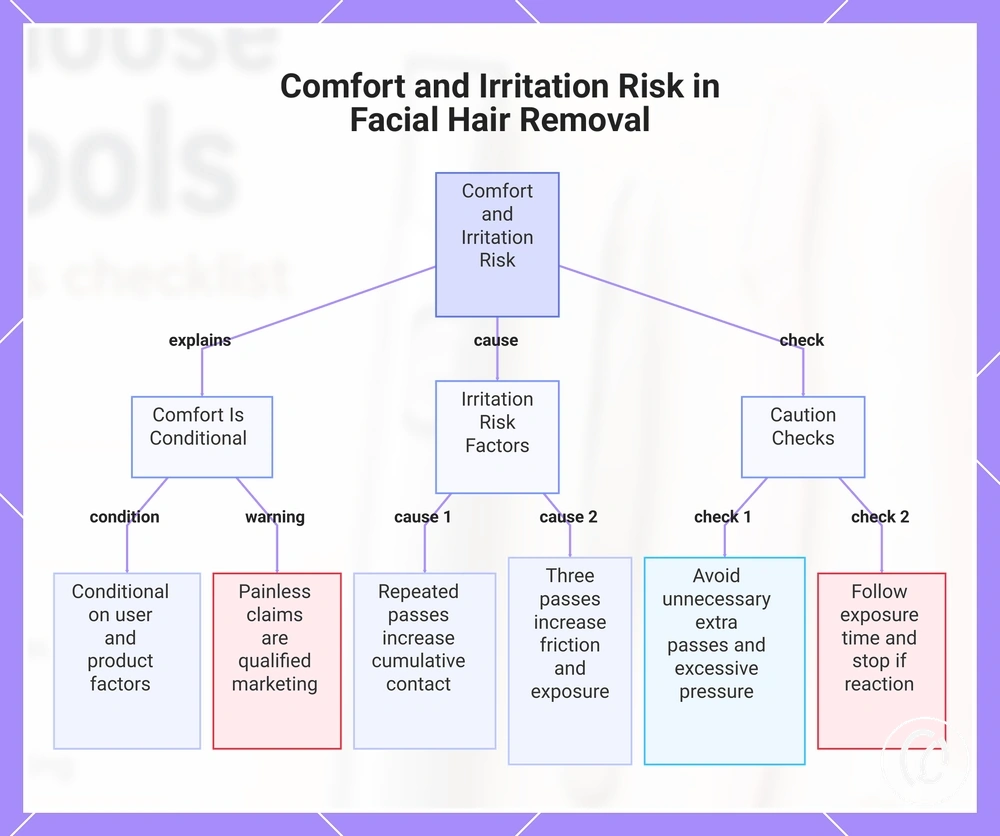
Comfort when using a facial hair removal tool is conditional on skin type, hair characteristics, tool contact, and technique, so painless claims should be interpreted as qualified marketing statements rather than universal outcomes. Irritation risk increases when friction, pressure, ingredient exposure, or repeated passes increase skin contact, and no facial hair removal method can reliably guarantee a pain-free or zero-irritation experience for every user. Comfort claims therefore require qualification before they are used as a suitability criterion. :contentReference[oaicite:0]{index=0}
Comfort claims therefore require qualification before they are used as a suitability criterion.
Discomfort is more likely when unnecessary friction, excessive pressure, prolonged ingredient exposure, or repeated passes increase cumulative skin contact. For example, making three passes over the same upper-lip area instead of one creates more friction and skin exposure, although no authoritative organisation specifies a universal numerical threshold at which irritation begins because responses differ between individuals and products. If redness, burning, persistent discomfort, or another unexpected skin reaction develops, treat it as a stop-use signal and reassess the tool's suitability before continuing, particularly if you have reactive skin or recent facial irritation. :contentReference[oaicite:1]{index=1}
Discomfort is more likely when unnecessary friction, excessive pressure, prolonged ingredient exposure, or repeated passes increase cumulative skin contact.
Comfort, Irritation Risk, and Painless Claims should be interpreted using the following caution checks:
- Friction: Repeated rubbing over the same facial area increases irritation risk, so avoid unnecessary extra passes whenever adequate hair removal has already been achieved.
- Pressure: Applying more pressure does not confirm better hair removal and can increase discomfort or visible skin reaction.
- Ingredient exposure: Depilatory creams should remain on the skin only for the period specified by the manufacturer because longer exposure may increase the likelihood of irritation.
- Repeated passes: Multiple passes increase cumulative skin contact, making careful technique preferable to repeated attempts over the same area.
- Reactive skin or uncertainty: If your skin is already irritated, recently sensitised, or you are unsure whether a facial hair removal tool is suitable, proceed cautiously and stop use if unexpected irritation develops.
This chart outlines the conditional nature of comfort, key irritation risk factors, and essential caution checks for facial hair removal.
Facial Hair Remover Selection Checklist
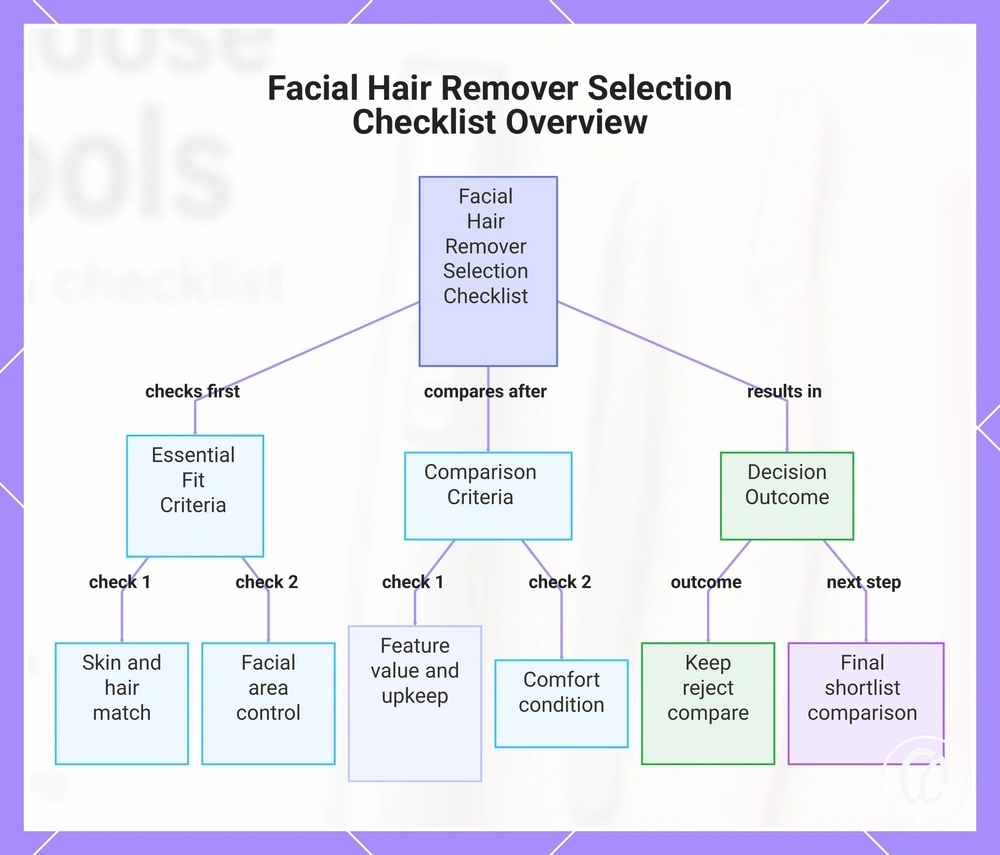
A Facial Hair Remover Selection Checklist verifies whether a facial hair removal tool fits the user’s need before they compare options. The primary fit criteria are skin tolerance, hair texture, facial area, feature value, upkeep, and comfort condition rather than feature quantity or product hype. The checklist therefore functions as a final fit verification step. :contentReference[oaicite:0]{index=0}
The checklist therefore functions as a final fit verification step.
Start by rejecting any option that conflicts with an essential criterion, including unsuitable skin contact, inadequate control for the intended facial area, or a mismatch with the target hair texture. Keep an option when it satisfies every essential fit condition, and compare remaining options by convenience attributes such as cleaning effort, charging method, portability, and visibility. A convenience feature should not reverse a rejection caused by poor essential fit. This creates a clear keep, reject, or compare decision for each option.
This creates a clear keep , reject , or compare decision for each option.
The Facial Hair Remover Selection Checklist below verifies each user need and converts the result into a practical decision before product comparison.
- Skin tolerance: Keep the option when its contact method matches your known tolerance; reject it when the intended method has previously caused unacceptable irritation or discomfort.
- Hair texture: Keep the option when its removal method matches fine hair, peach fuzz, coarse hair, or short regrowth; reject it when the tool cannot address the target texture without excessive repeated passes.
- Facial area: Keep the option when its size and control suit the upper lip, chin, cheeks, or jawline being treated; reject it when the design obstructs positioning on the intended contour.
- Feature value: Keep a feature when it solves a defined need such as visibility, guarded contact, or portability; compare secondary features only after essential fit is confirmed.
- Upkeep: Keep the option when cleaning, charging, battery replacement, or blade maintenance fits your expected use frequency; reject it when the required upkeep is impractical for your routine.
- Comfort condition: Compare options using qualified comfort expectations; reject an option when it conflicts with your known limits or produces a repeated stop-use signal.
- Final shortlist: Compare only the options that pass every essential criterion, then use convenience, upkeep, and use frequency to separate otherwise suitable candidates.
Passing the checklist identifies suitable candidates rather than guaranteeing one outcome for every user. After narrowing the shortlist, review the best options by need and make the final decision using the same fit criteria.
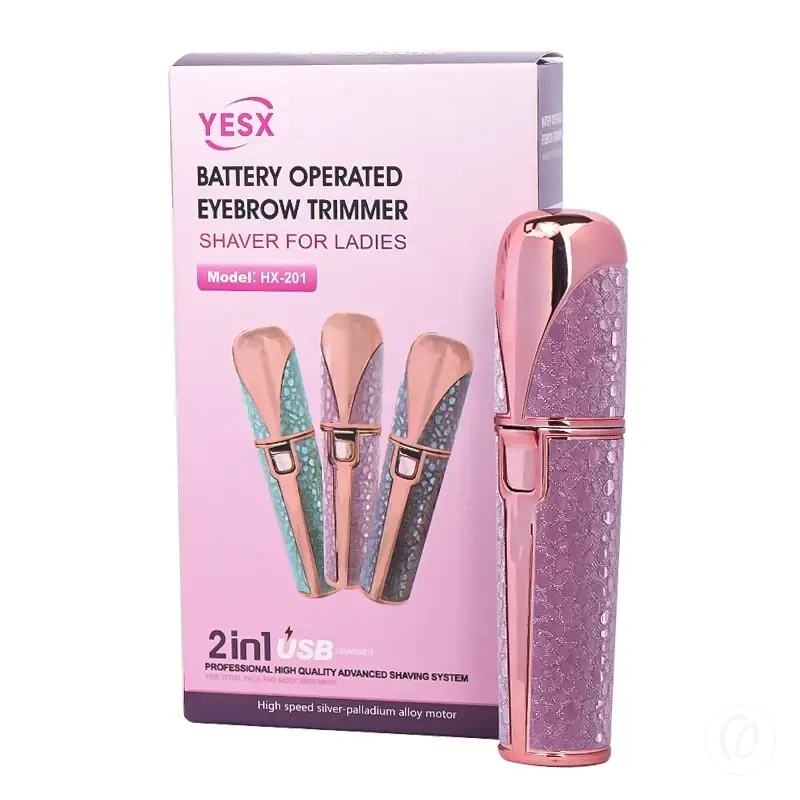
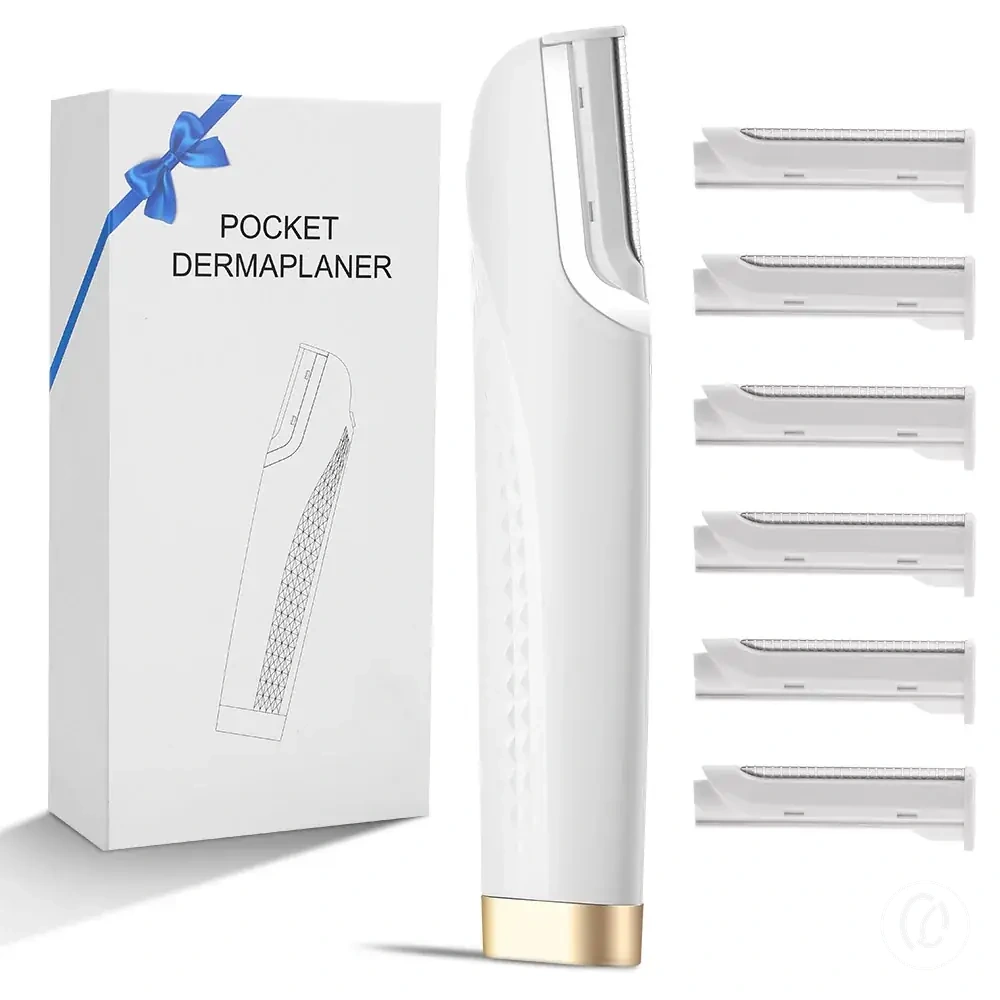
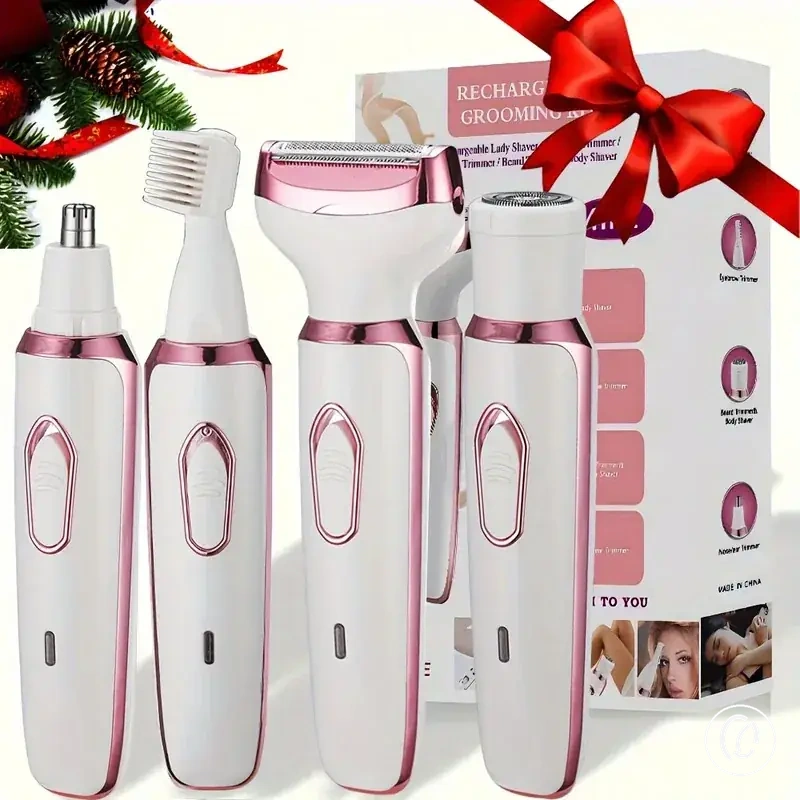
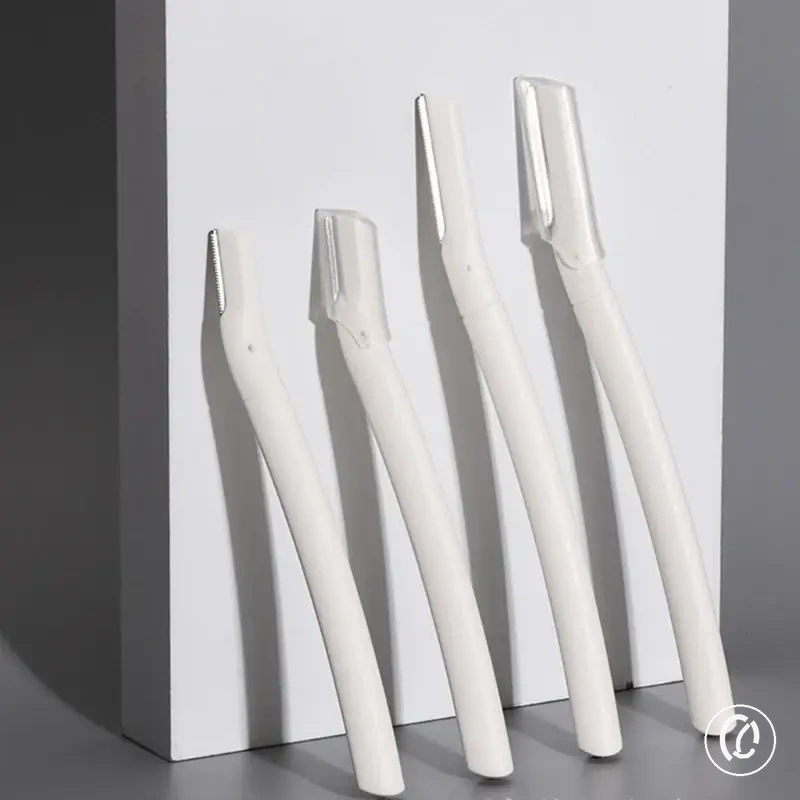
The products below are useful examples for comparing available options.
The products below are useful examples for comparing available options. Before buying, check that the compatibility criteria, key features, and product details match your needs.
This chart shows the main steps of the checklist: checking essential fit criteria, evaluating comparison criteria, and making a keep/reject/compare decision.
Match the Tool to the Main Constraint
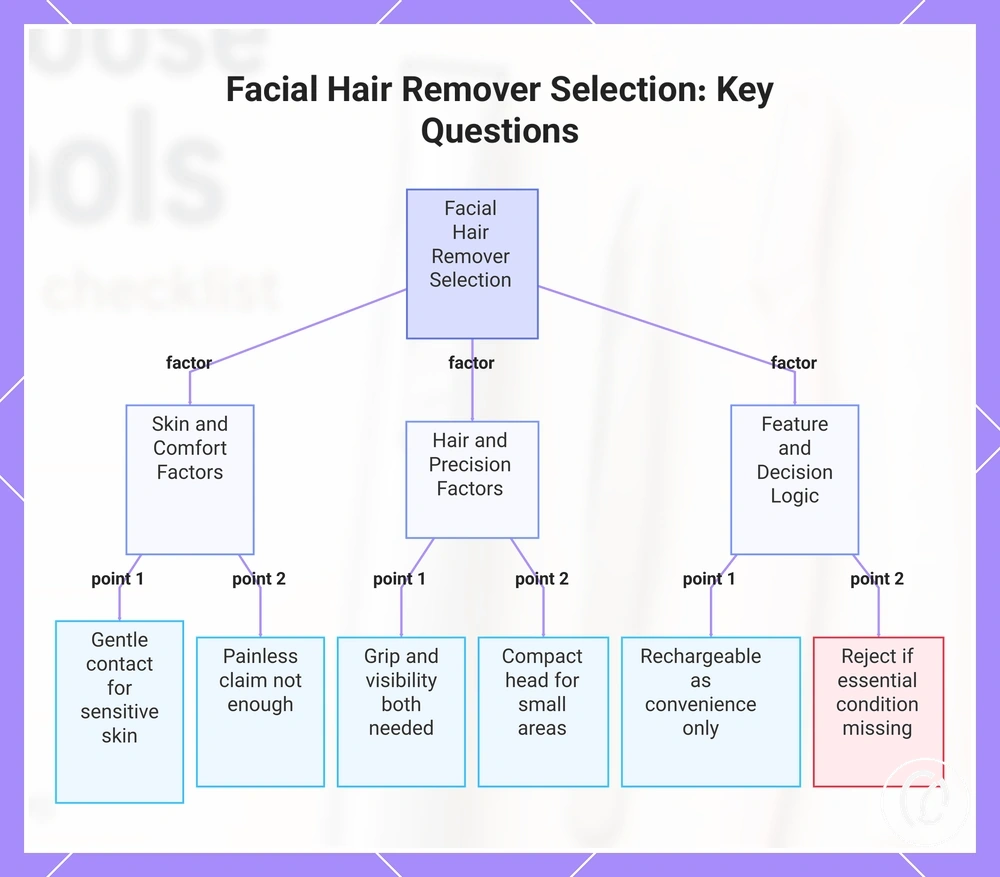
The main constraint should control the facial hair remover selection priority because the strongest constraint determines which tool characteristics should be prioritised or avoided. Identify whether skin sensitivity, coarse hair, fine hair, small-area precision, or convenience is the dominant user need, then let that single constraint lead the choice. Match the Tool to the Main Constraint uses the criteria below to set that priority. :contentReference[oaicite:0]{index=0}
- Skin sensitivity: Prioritise gentle contact, controlled pressure, and limited repeated passes; avoid methods that require aggressive friction or conflict with known skin tolerance.
- Coarse hair: Prioritise stable grip, consistent hair capture, and tolerance for controlled repeated use; avoid compensating for weak capture with additional pressure.
- Fine hair: Prioritise visibility, precise positioning, and light surface contact; avoid designs that obstruct fine-hair visibility or require unnecessary repeated passes.
- Small-area precision: Prioritise a compact head and clear access around narrow facial contours; avoid tool shapes that reduce control on the upper lip or chin.
- Convenience: Prioritise portability, manageable upkeep, and a suitable power source only after core fit is confirmed; avoid allowing rechargeability, an LED light, or compact storage to outweigh a mismatch in skin, hair, or facial-area suitability.
Check Upkeep, Replacement, and Use Frequency
Upkeep, replacement, and use frequency determine whether a facial hair remover remains practical after purchase because its cleaning need, replacement head or blade availability, battery habit, ongoing cost, convenience, and hygiene requirements must match the user’s routine. Reject a tool when its required upkeep is unlikely to be followed consistently, because maintenance suitability affects practical fit after purchase. :contentReference[oaicite:0]{index=0}
Reject a tool when its required upkeep is unlikely to be followed consistently, because maintenance suitability affects practical fit after purchase.
Check Upkeep, Replacement, and Use Frequency uses the following checks to verify long-term practicality:
- Cleaning need: Confirm that the cleaning routine is realistic for your normal use; avoid a tool whose hygiene requirements are likely to be skipped after regular grooming.
- Replacement head or blade: Check whether the required replacement part is available and whether its cost remains acceptable at your expected use frequency; avoid a design that becomes impractical when the head or blade wears or needs replacement.
- Battery habit: Match rechargeability or replaceable-battery use to your charging access, travel pattern, and touch-up routine; avoid a power setup that adds repeated inconvenience.
- Use frequency: Frequent use increases the importance of convenient cleaning, accessible replacement parts, and manageable ongoing cost; reject the tool if its maintenance demand exceeds the routine you are willing to maintain.
Common Selection Mistakes Before Buying
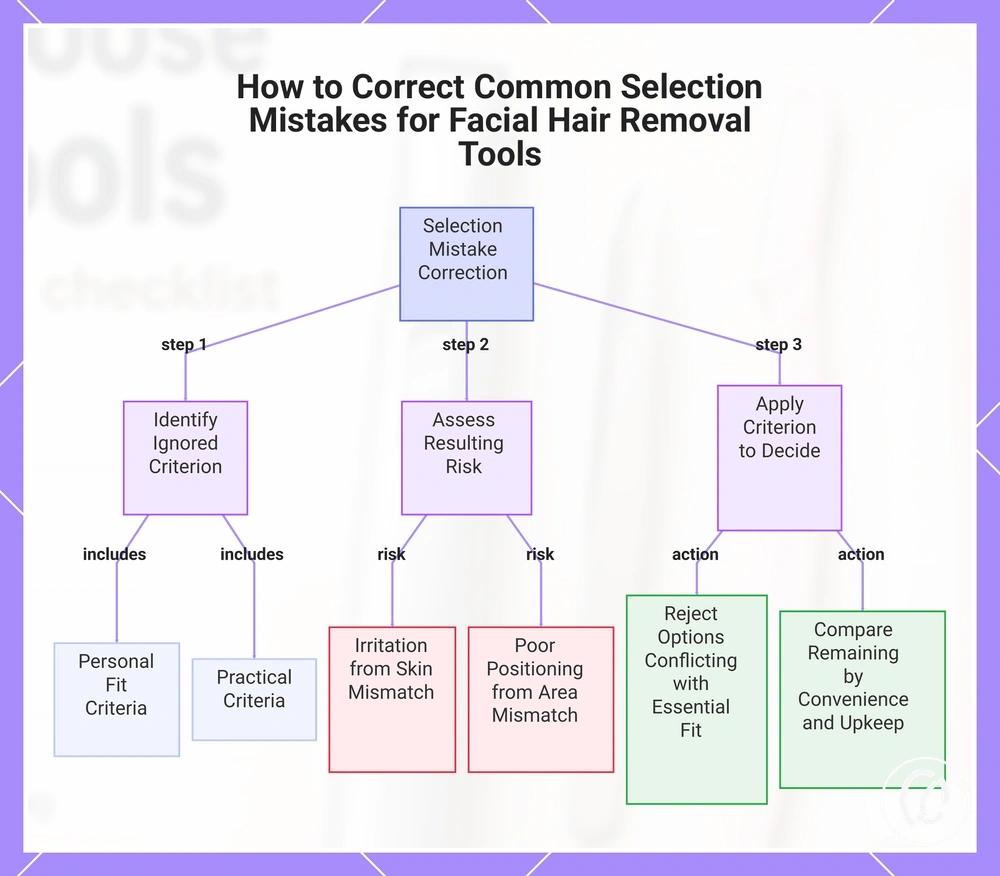
Common selection mistakes before buying reduce facial hair removal tool fit when the decision ignores a controlling criterion such as skin tolerance, hair texture, facial area, feature value, or upkeep. The correction is to identify the ignored attribute, assess the resulting risk, and use that criterion to make a better decision. Most buying mistakes come from overlooking fit criteria rather than from comparing too few features. :contentReference[oaicite:0]{index=0}
The practical correction is to separate essential fit from secondary convenience before purchase.
A tool with an LED light, rechargeable battery, and compact case may appear convenient, yet those features do not correct a mismatch with reactive skin, coarse chin hair, or a narrow upper-lip area. A comfort claim may also sound reassuring while leaving friction, pressure, repeated passes, or ingredient exposure unspecified. The practical correction is to separate essential fit from secondary convenience before purchase. Common Selection Mistakes Before Buying uses the mistake-and-correction list below to apply that distinction.
- Mistake: prioritising feature quantity. The ignored criterion is feature value, creating a risk that convenience features outweigh essential fit. Correction: confirm that each feature solves a defined need and compare it only after skin, hair, and area suitability are established.
- Mistake: treating a comfort claim as universal. The ignored criterion is skin tolerance, which can increase irritation risk when the contact method or technique is unsuitable. Correction: assess friction, pressure, repeated passes, and known skin reactions instead of relying on the claim alone.
- Mistake: ignoring hair texture. The ignored criterion is the match between fine hair, peach fuzz, coarse hair, or short regrowth and the tool’s contact method. Correction: check whether the tool provides the visibility, grip, or controlled cutting required by the target hair texture.
- Mistake: overlooking facial area. The ignored criterion is the control required by the treatment zone, creating a risk of poor positioning on narrow or curved contours. Correction: verify that the tool’s head size, visibility, and handling suit the intended facial area.
- Mistake: overlooking upkeep. The ignored criterion is long-term practicality, including cleaning, replacement-part access, battery habit, and use frequency. Correction: reject an option when its expected maintenance, cost, or hygiene routine is unlikely to be followed consistently.
- Mistake: allowing one strength to excuse another weakness. The ignored criterion is the main constraint, creating decision risk when portability, power, or convenience is used to excuse poor core suitability. Correction: let the strongest need control the choice and use secondary features only to separate otherwise suitable options.
Apply each correction to remove options that conflict with an essential criterion, then compare the remaining tools by convenience and upkeep rather than product hype. This approach reduces pre-purchase decision risk without implying that passing every check guarantees the same outcome for every user.
Before buying, check that the compatibility criteria, key features, and product details match your needs.
The products below are useful examples for comparing available options. Before buying, check that the compatibility criteria, key features, and product details match your needs.
This chart shows the three-step correction process and the key fit criteria to check before buying a facial hair removal tool.
Residual Questions Before Choosing a Facial Hair Remover
Should a facial hair remover be chosen differently for sensitive skin?
Yes, a facial hair remover for sensitive skin should prioritise gentle contact and controlled use rather than comfort marketing alone. Suitability is stronger when the contact method matches known skin tolerance and does not require excessive pressure or repeated passes. Treat redness, burning, or persistent discomfort as a reason to stop and reconsider the decision. :contentReference[oaicite:0]{index=0}
Can one facial hair remover suit both coarse hair and fine hair?
It can, but only when the tool provides enough grip for coarse hair and enough visibility and precision for fine hair. A broad capability claim is not enough if one hair type requires extra pressure or repeated passes. Confirm suitability against the hair texture that creates the greatest difficulty.
Is a painless claim enough to confirm comfort?
No, painless claims do not establish the same comfort level for every user. Friction, pressure, ingredient exposure, facial area, and skin tolerance can change the experience. Use painless wording as a secondary feature claim, not as the main selection criterion.
Do rechargeable features improve removal performance?
No, rechargeable features mainly improve convenience and battery management rather than cutting ability. Their feature value increases when use frequency is high or disposable-battery replacement would be inconvenient. Consider rechargeability only after skin, hair, and facial-area fit are confirmed.
What matters most for precision on the upper lip or chin?
Precision on the upper lip or chin depends on compact head control, clear visibility, and stable handling. A tool suited to broad cheek coverage may offer less control on narrow or curved areas. Base the decision on the smallest facial area you expect to treat.
When should a facial hair remover be rejected before purchase?
A facial hair remover should be rejected when an essential suitability condition is missing, such as acceptable skin contact, adequate control, hair-texture fit, or realistic upkeep. Convenience features should not compensate for one of those limitations. Compare only the options that satisfy the user’s main constraint.
Compare only the options that satisfy the user’s main constraint.
This chart shows the main factors to consider when choosing a facial hair remover, including skin sensitivity, hair texture, precision, and decision rules.