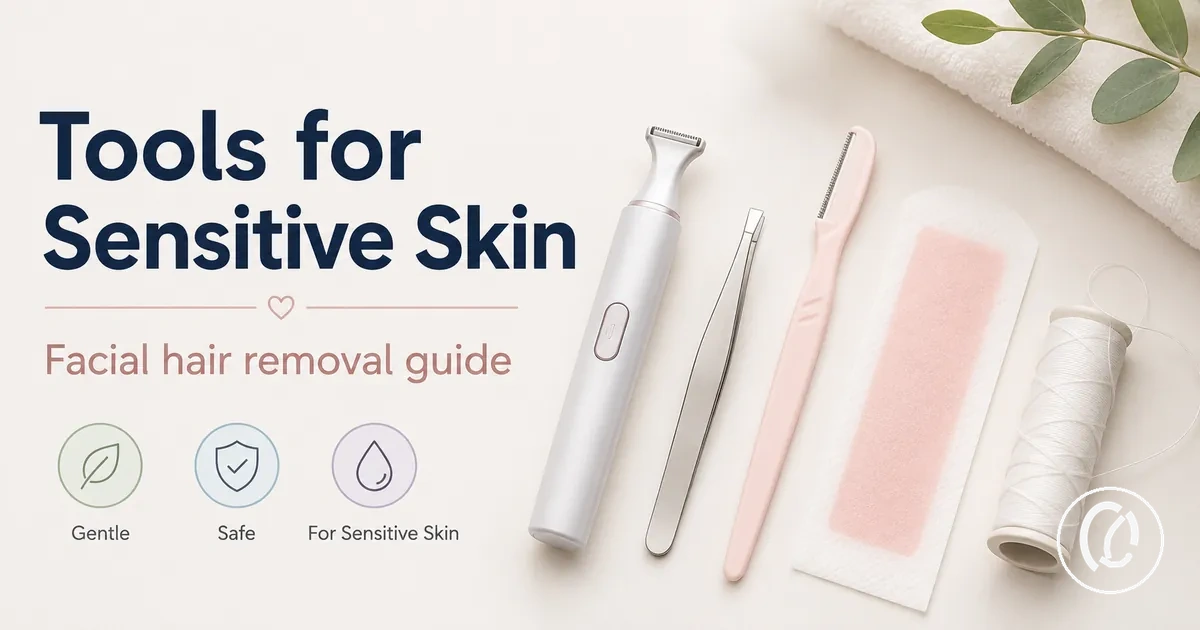
Facial Hair Removal Tools for Sensitive Skin
Facial hair removal tools for sensitive skin should be selected by their ability to limit avoidable friction, pulling, pressure, and repeated skin contact rather than by a painless claim. Tool suitability remains conditional because active irritation, facial area, hair texture, removal mechanism, and user technique can change the skin response. A gentle facial hair remover therefore means a tool used under lower-irritation conditions, not a tool that guarantees comfort for every user.
Skin condition sets the first safety boundary for facial hair removal tools.
Skin condition sets the first safety boundary for facial hair removal tools. The American Academy of Dermatology Association advises using light pressure and a sharp blade when shaving and notes that shaving can aggravate facial acne; Healthdirect Australia also identifies shaving, tweezing, and waxing as hair-removal methods that can precede ingrown hairs. Facial hair removal should therefore be postponed on visibly inflamed, broken, infected, or recently irritated skin until the condition has settled or a healthcare professional has advised otherwise.
Tool comparison should focus on removal depth, exposed cutting surfaces, pulling force, cleaning access, and the number of passes needed for the facial area and hair type.
Tool comparison should focus on removal depth, exposed cutting surfaces, pulling force, cleaning access, and the number of passes needed for the facial area and hair type. Electric removers and guarded trimmers cut hair at or near the surface, while epilating and waxing tools remove hair from the root and apply pulling force; facial razors and dermaplaning tools depend more directly on blade condition, angle, pressure, and stroke control. A hypoallergenic label describes a manufacturer claim rather than verified universal compatibility, so contact materials and cleaning instructions still require checking before use.
No facial hair removal tool is established as irritation-free for every person with sensitive skin.
No facial hair removal tool is established as irritation-free for every person with sensitive skin. Product examples should remain secondary decision aids and should be assessed against the user's current skin condition, the intended facial area, hair thickness, cleaning requirements, and the manufacturer's safe-use limits rather than treated as guaranteed outcomes.
Table of Contents
Why Sensitive Skin Needs a Lower-Irritation Tool Choice
Sensitive skin needs a facial hair remover that limits avoidable friction, pulling, pressure, and repeated contact because these mechanical triggers can increase stinging, burning, itching, redness, or bumps. The 2017 review Sensitive Skin: Review of an Ascending Concept in Anais Brasileiros de Dermatologia describes sensitive skin as a condition associated with stinging, burning, and itching and identifies skin-barrier impairment as a contributor to hyperreactivity. Tool suitability is therefore conditional on the removal mechanism and the condition of the skin at the time of use.
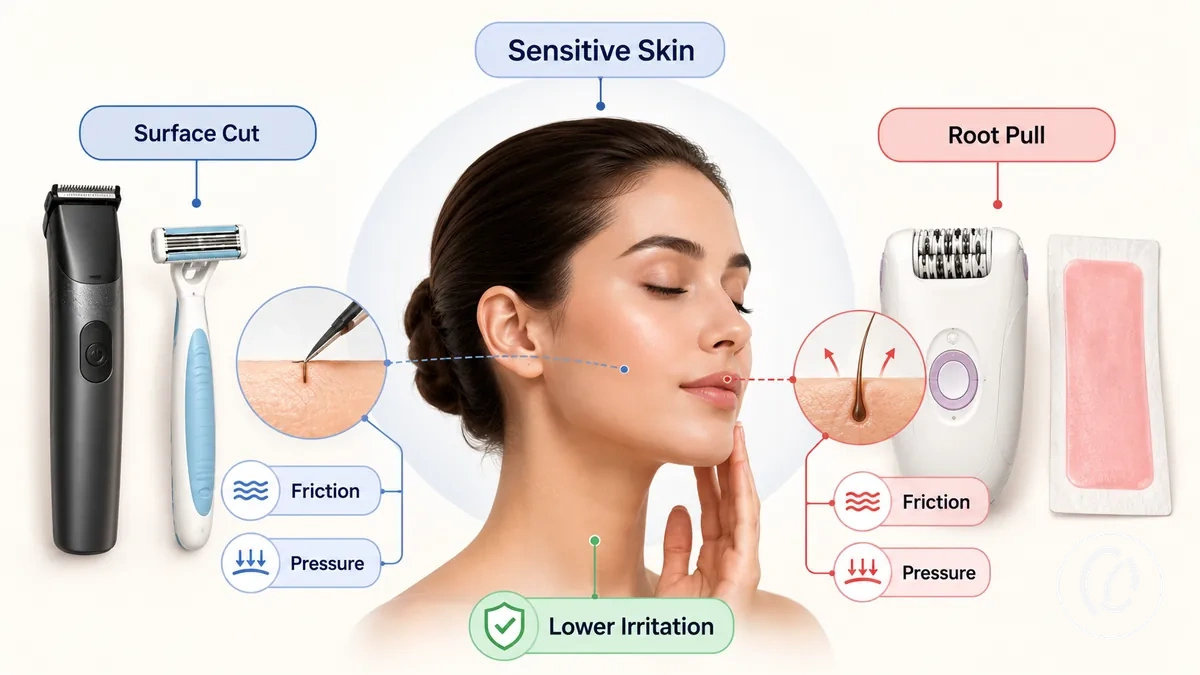
For sensitive skin, facial hair removal tools create two main mechanical exposure categories: surface-cutting tools rely on blade contact and pressure, while root-removal tools add pulling force. The American Academy of Dermatology Association reports that shaving can irritate skin, worsen facial acne, and cause cuts, razor burn, or ingrown hairs; it advises using a sharp blade and light pressure to reduce avoidable injury. Active redness, broken skin, persistent stinging, or inflamed bumps therefore changes the appropriate choice from using a gentle tool to postponing removal until the skin has recovered or received clinical advice.
This distinction provides a practical mechanism-based signal without classifying every surface tool as suitable or every root-removal tool as unsuitable.
A lower-irritation comparison should evaluate contact area, exposed cutting surfaces, pulling force, cleaning access, and the number of passes required for the facial area and hair type. Surface-cutting tools avoid root pulling but still create friction, while epilating and waxing tools remove hair from the root and add traction to the skin and follicle. This distinction provides a practical mechanism-based signal without classifying every surface tool as suitable or every root-removal tool as unsuitable.
Surface-cutting tools avoid root pulling but still create friction, while epilating and waxing tools remove hair from the root and add traction to the skin and follicle.
A hypoallergenic label or painless claim does not establish universal compatibility because neither claim verifies how an individual will respond to a tool’s material, pressure, vibration, heat, or removal mechanism. Lower-irritation tool choice means reducing identifiable triggers under suitable skin conditions; it does not mean that a facial hair remover is painless or risk-free for every user.
Irritation, Redness, Razor Bumps, and Ingrown-Hair Risk
Irritation, redness, razor bumps, and ingrown-hair risk are the main reaction signals that indicate a facial hair removal tool or technique may be creating excessive friction, pulling, pressure, or hair re-entering the skin instead of matching sensitive-skin needs. According to the American Academy of Dermatology Association (AAD), shaving can lead to razor burn, cuts, and ingrown hairs, while Mayo Clinic reports that ingrown hairs commonly develop after shaving, tweezing, or waxing when hair grows back into the skin. Recognising these reaction signals helps make facial hair removal tool selection a safety-led decision rather than continuing with a method that repeatedly irritates the skin.
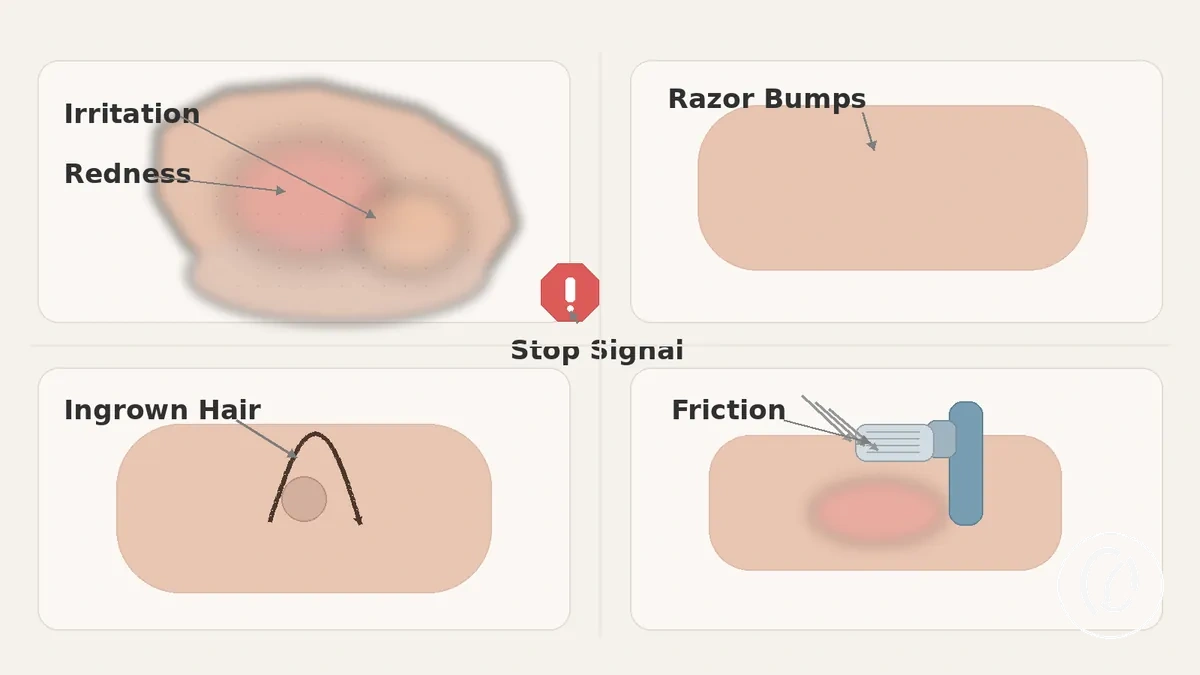
The following reaction signals organise the key safety checks for sensitive skin:
- Irritation: Trigger: repeated friction or excessive pressure. Visible symptom: burning, stinging, or tenderness during or shortly after hair removal. Decision effect: reduce pressure, avoid repeated passes, or stop until the skin settles.
- Redness: Trigger: blade contact, repeated strokes, or root pulling. Visible symptom: temporary redness or warmth. Decision effect: allow recovery before another session if redness persists instead of increasing pressure.
- Razor bumps: Trigger: closely cut hairs curling back toward the skin after shaving. Visible symptom: small raised bumps that can resemble acne. Decision effect: review shaving direction, pressure, and tool suitability. Cleveland Clinic identifies this as pseudofolliculitis barbae.
- Ingrown hair: Trigger: shaved, tweezed, waxed, or epilated hair growing back into the skin. Visible symptom: inflamed bumps, tenderness, or itching. Decision effect: avoid further hair removal over the affected area until irritation improves. Mayo Clinic identifies these as common outcomes of trapped regrowing hairs.
- Reaction signal: Trigger: repeated irritation after shaving, trimming, waxing, or epilating. Visible symptom: recurring redness, bumps, or stinging after each session. Decision effect: reassess the removal method rather than repeating the same technique under identical conditions.
For example, if redness appears immediately after shaving and razor bumps develop within the next 24 to 48 hours, the timing suggests that friction, hair direction, or excessive closeness may be contributing to the reaction instead of the tool alone. If this pattern repeats despite careful technique, review facial hair removal irritation fixes before performing another facial hair removal session.
Surface Trimming versus Hair Removal from the Root
Surface trimming and root removal differ by their hair-removal mechanism rather than by overall tool quality. Surface trimming cuts hair at or just above the skin surface with blade contact, while root removal extracts the hair from the follicle and adds pulling force. According to the American Academy of Dermatology Association (AAD), shaving removes hair at the skin surface, whereas tweezing, waxing, threading, and epilating remove hair from the root; this distinction helps explain why irritation sensitivity depends on the removal mechanism, skin contact, and the condition of sensitive skin.
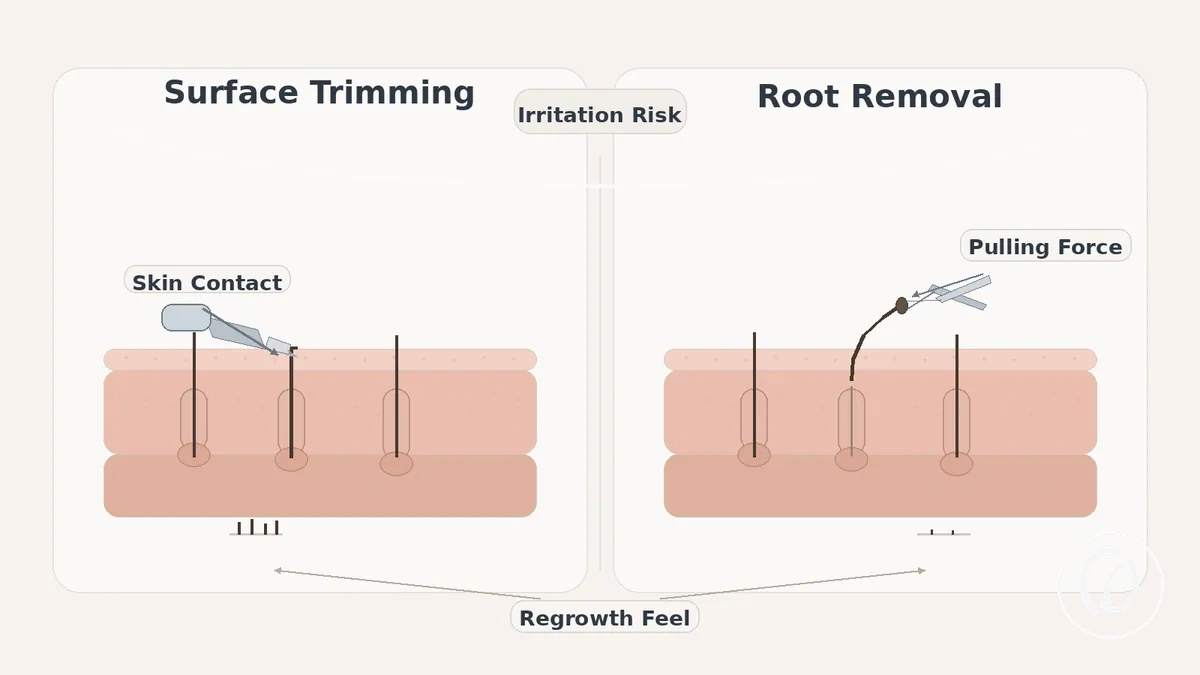
The comparison below focuses on removal depth, pulling force, skin contact, regrowth feel, and irritation sensitivity as decision variables rather than implying that one approach is universally safer.
| Option | Attribute | Trade-off | Sensitive-skin decision |
|---|---|---|---|
| Surface trimming | Removal depth | Cuts hair at or just above the skin surface using blade contact and light pressure without removing the follicle. | Often preferred when reducing pulling force is the priority, provided the blade is clean and pressure remains light. |
| Surface trimming | Regrowth feel | Hair is cut across the shaft, so regrowth can feel blunt even though the hair is not thicker. | More frequent maintenance may be needed because the hair remains in the follicle. |
| Root removal | Pulling force | Removes the hair from the follicle through waxing, threading, tweezing, or epilating, creating traction on both the hair and surrounding skin. | May increase irritation sensitivity in reactive skin because extraction produces more mechanical stress than surface cutting. |
| Root removal | Skin contact and regrowth | Hair-free results usually last longer because the follicle is emptied. The American Academy of Dermatology Association notes that waxing generally lasts about 3 to 4 weeks before regrowth becomes noticeable, although individual hair-growth cycles differ. | May be appropriate only when sensitive skin tolerates root pulling without repeated redness, bumps, or prolonged irritation. |
For example, if facial hair becomes visible again after 2 days following surface trimming but remains absent for about 3 weeks after waxing, the longer interval reflects the difference in removal depth rather than a guarantee of better skin comfort. The more suitable choice depends on whether reduced pulling force or a longer regrowth interval is the more important decision criterion for sensitive skin.
Gentle Tool Types for Sensitive Facial Skin
Gentle facial hair removal tool types for sensitive skin are best compared by their removal mechanism, skin contact, pulling force, precision, and friction rather than by claims that one option is universally safer. According to the American Academy of Dermatology Association (AAD), shaving removes hair at the skin surface, whereas tweezing and waxing remove hair from the root. For sensitive skin, this distinction makes surface-cutting tool families a lower-pulling option, while root-removal methods require the skin to tolerate follicle extraction without recurring irritation.
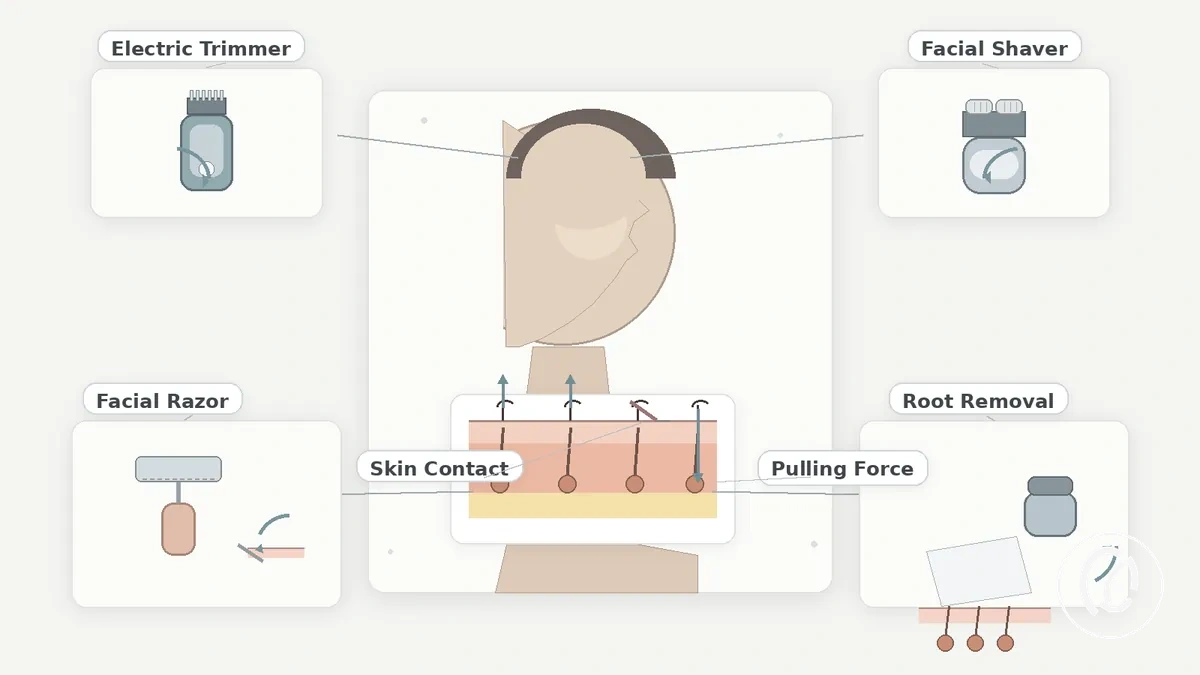
Electric trimmers and facial shavers reduce pulling force because they cut the hair shaft instead of extracting the follicle, while facial razors and dermaplaning tools rely more heavily on blade angle, pressure, and repeated passes. Epilators and waxing tools remove hair from the root, increasing mechanical traction on the follicle and surrounding skin. According to the AAD, shaving with light pressure and a sharp blade helps reduce avoidable irritation, while root-removal methods should be considered only when sensitive skin consistently tolerates that removal mechanism.
Epilators and waxing tools remove hair from the root, increasing mechanical traction on the follicle and surrounding skin.
The table below compares the main tool families using the decision variables that most directly influence irritation avoidance for sensitive facial skin.
| Option | Attribute | Trade-off | Sensitive-skin decision |
|---|---|---|---|
| Electric trimmer | Skin contact | Guarded cutting elements trim hair close to the skin without removing the follicle. | Often the preferred tool family when reducing pulling force is the primary decision criterion. |
| Facial shaver | Precision | Cuts hair at the skin surface with a foil or rotary guard but repeated passes can increase friction. | Suitable when light pressure, clean cutting heads, and controlled passes are maintained. |
| Facial razor or dermaplaning tool | Blade angle and pressure | Produces a close surface cut but depends on blade sharpness, blade angle, and user technique. | Conditionally suitable if the skin barrier is healthy and unnecessary repeated strokes are avoided. |
| Epilator or waxing tool | Pulling force | Extracts hair from the follicle, creating greater mechanical traction than surface-cutting methods. | Most appropriate only for users whose sensitive skin consistently tolerates root removal without recurring redness, razor bumps, or prolonged irritation. |
For example, if facial hair becomes noticeable again after about 2 days following surface trimming but remains absent for approximately 3 to 4 weeks after waxing, the longer interval reflects root removal rather than surface cutting. According to the American Academy of Dermatology Association, waxing commonly keeps skin hair-free for about 3 to 4 weeks, although the exact interval depends on the individual's hair-growth cycle and treatment area.
Electric Facial Trimmers and Shavers
Electric facial trimmers and electric facial shavers can reduce certain irritation risks for sensitive skin because they cut hair at or near the skin surface instead of removing it from the follicle, reducing pulling as the primary mechanical difference. According to the American Academy of Dermatology Association (AAD), shaving removes hair at the skin surface, unlike waxing or tweezing, which remove hair from the root. Within this comparison, the decision depends on guard design, blade exposure, pressure, and skin contact rather than on whether the tool is electric alone.
Users who react to vibration , motor heat, or repeated passes may still experience irritation even when root pulling is avoided.
An electric facial trimmer typically uses a guard that limits direct blade exposure, leaving a small amount of visible hair while reducing direct skin contact. An electric facial shaver generally cuts closer to the skin with a foil or rotary tool head, which may require additional passes on coarse or uneven facial hair. A removable head with good cleaning access allows trapped hair and residue to be removed after each use, while flexible head movement can distribute pressure more evenly across facial contours. Users who react to vibration, motor heat, or repeated passes may still experience irritation even when root pulling is avoided.
According to the retained section evidence, the comparison below summarises the main comfort-related decision variables for sensitive facial skin.
According to the retained section evidence, the comparison below summarises the main comfort-related decision variables for sensitive facial skin. :contentReference[oaicite:0]{index=0}
| Option | Attribute | Trade-off | Sensitive-skin decision |
|---|---|---|---|
| Electric facial trimmer | Guard design and blade exposure | Guarded blades reduce direct skin contact but leave slightly more visible hair than a close shaver. | Often preferred when reducing blade exposure and avoiding follicle pulling are the main priorities. |
| Electric facial shaver | Closeness of cut and tool head movement | Foil or rotary heads produce a closer surface cut but may require repeated passes on dense facial hair. | Use light pressure because repeated passes can increase friction on sensitive skin. |
| Either electric tool | Cleaning access | Removable heads make it easier to clear hair, oil, and skin residue after use. | Regular cleaning supports hygiene and reduces residue that could contribute to irritation during later use. |
| Either electric tool | Pressure, vibration, and heat sensitivity | Electric operation avoids root pulling but does not eliminate vibration or motor warmth. | Choose shorter sessions or discontinue use if vibration, heat, or repeated passes consistently trigger discomfort. |
For example, if one side of the upper lip becomes comfortable after a single pass with an electric facial trimmer but another area requires three passes with an electric facial shaver, the extra skin contact—not the electric motor itself—may increase friction on sensitive skin. This illustrates why the number of passes, guard design, and pressure are more useful comparison criteria than marketing claims such as "painless" or "hypoallergenic." :contentReference[oaicite:1]{index=1}
Facial Razors and Dermaplaning Tools
A facial razor or dermaplaning tool may suit sensitive skin when a sharp blade, controlled blade angle, light pressure, and precise facial-area control minimise repeated blade contact. The same manual blade tools are more likely to increase friction when the blade is dull, the blade angle becomes steep, or repeated strokes are made over the same area. According to the American Academy of Dermatology Association (AAD), shaving with a sharp blade and light pressure helps reduce avoidable irritation, making blade contact and pressure the key comparison criteria for this tool category. :contentReference[oaicite:0]{index=0}
Skin prep should begin with clean skin, while hygiene requires a clean blade that is replaced or maintained according to the manufacturer's instructions.
Skin prep should begin with clean skin, while hygiene requires a clean blade that is replaced or maintained according to the manufacturer's instructions. A guarded facial razor limits direct blade exposure and can improve control on smaller facial areas, whereas a dermaplaning tool uses a more exposed blade that requires greater precision in blade angle and pressure. Cleveland Clinic explains that dermaplaning removes the uppermost layer of skin with a specialised blade, so active redness, broken skin, or inflamed acne changes the decision from careful use to postponing blade contact until the skin has recovered. :contentReference[oaicite:1]{index=1}
The comparison below summarises the key decision criteria without implying that either tool is suitable for every user.
Pressure and blade contact are the main variables that determine whether manual blade tools remain appropriate for sensitive skin. The comparison below summarises the key decision criteria without implying that either tool is suitable for every user.
| Option | Attribute | Trade-off | Sensitive-skin decision |
|---|---|---|---|
| Guarded facial razor | Guard design | Reduced blade exposure improves facial-area control but still requires correct blade angle and light pressure. | Suitable only when one controlled pass removes the visible hair without repeated strokes. |
| Dermaplaning tool | Blade angle | An exposed blade provides closer surface contact but leaves less margin for pressure or angle errors. | Use only on calm, intact skin and stop if dragging, stinging, or persistent redness develops. |
| Either manual blade | Blade sharpness and hygiene | A dull or unclean blade increases drag and residue during skin contact. | Replace or clean the blade according to the manufacturer's guidance before further use if pulling or contamination is evident. |
| Either manual blade | Repeated passes | Each additional stroke increases blade-contact events and cumulative friction on the same facial area. | Reduce repeated strokes by reassessing blade condition, hair direction, or tool choice instead of applying more pressure. |
For example, suppose one cheek requires a single light stroke while a curved chin area needs three strokes with the same facial razor. That illustrative comparison creates three blade-contact events instead of one on the chin, increasing friction exposure even though the tool has not changed. This example is hypothetical and demonstrates why current skin condition and technique remain the deciding factors for sensitive skin. :contentReference[oaicite:2]{index=2}
Epilators, Waxing Tools, and Higher-Pull Methods
Higher-pull methods, including an epilator and a waxing tool, can be more challenging for sensitive facial skin because they remove hair through root removal rather than surface cutting. The comparison is based on pulling force, adhesive or heat exposure, contact with the skin, and repeated mechanical trauma instead of overall tool quality. According to the American Academy of Dermatology Association (AAD), waxing, tweezing, and epilating remove hair from the root, making them mechanically different from shaving or trimming and more likely to produce temporary redness or discomfort in people with reactive skin. :contentReference[oaicite:0]{index=0}
The comparison is based on pulling force , adhesive or heat exposure, contact with the skin, and repeated mechanical trauma instead of overall tool quality.
The comparison below separates pulling force, heat, adhesive contact, and repeated trauma because each factor changes the sensitive-skin decision differently. An epilator repeatedly grips and extracts individual hairs with rotating tweezers, while a waxing tool removes multiple hairs simultaneously through adhesive contact and, for warm wax products, heat exposure. According to the AAD, waxing commonly delays visible regrowth for approximately 3 to 4 weeks, although the interval depends on the individual's hair-growth cycle rather than the waxing method alone. :contentReference[oaicite:1]{index=1}
| Option | Attribute | Trade-off | Sensitive-skin decision |
|---|---|---|---|
| Epilator | Pulling force | Repeatedly extracts individual hairs from the follicle, creating continuous root-level traction. | Most suitable only when reactive skin tolerates repeated root removal without persistent redness or prolonged irritation. |
| Waxing tool | Adhesive contact and heat | Wax adheres to the hair before root removal, and warm wax products also expose the skin to heat. | Pause use if active irritation, broken skin, or inflamed facial conditions are already present. |
| Higher-pull methods | Pain likelihood | Root removal generally produces greater discomfort than surface-cutting methods because the hair is extracted from the follicle. | Users with low pain tolerance may find surface-cutting tools easier to tolerate for routine facial hair removal. |
| Either method | After-reaction pattern | Temporary redness may follow root removal, and repeated treatment before the skin recovers can prolong visible irritation. | Allow the skin to recover before another session if redness or irritation continues beyond the expected short-term reaction. |
For example, if facial hair becomes noticeable again after approximately 2 to 3 days following surface trimming but remains absent for about 3 to 4 weeks after waxing, the difference reflects surface cutting versus root removal rather than improved skin tolerance. This comparison illustrates why reactive skin, active irritation, and individual pain tolerance should guide the choice of a higher-pull method instead of the longer regrowth interval alone. According to the AAD, the longer interval is a result of follicle-level hair removal rather than a reduction in irritation risk. :contentReference[oaicite:2]{index=2}
Safety-Focused Features to Compare Before Choosing
A facial hair remover for sensitive skin should be compared by contact material, blade or head design, guard control, pressure handling, cleaning access, and replaceable parts because these features directly affect friction, pulling, residue, and irritation. A gentle design limits avoidable skin contact under its intended conditions, whereas a painless claim or hypoallergenic label does not establish tool suitability. The U.S. Food and Drug Administration states that no federal standard or definition governs the term “hypoallergenic,” so material disclosure and individual reaction history provide stronger selection signals than the label alone.
Safety-relevant features alter the cutting mechanism, skin contact, hygiene, or control of the facial hair removal tool.
Safety-relevant features alter the cutting mechanism, skin contact, hygiene, or control of the facial hair removal tool. A stable guard limits blade exposure, a flexible head can maintain contact across facial contours, and effective pressure handling allows visible hair removal without forceful pressing or repeated passes. Cleaning access should expose all skin-contact surfaces so hair and residue can be removed as directed, while replaceable blades, foils, or heads allow worn components to be changed. Colour, display type, storage accessories, and decorative finishes are convenience features unless they materially improve grip, cleaning, or contact control.
Colour, display type, storage accessories, and decorative finishes are convenience features unless they materially improve grip, cleaning, or contact control.
The table connects each feature to its required condition and likely irritation effect; broader selection criteria for facial hair removal tools can then be applied without treating comfort claims as verified performance.
| Entity/part | Attribute/criterion | Value/condition | Effect/risk/decision |
|---|---|---|---|
| Skin-contact surface | Contact material | The manufacturer identifies the material, and it excludes substances already known to trigger the user’s skin reaction. | An undisclosed material or an unsupported hypoallergenic claim provides insufficient evidence of sensitive-skin compatibility. |
| Blade or cutting head | Design and sharpness | The cutting edge removes visible hair without pulling, catching, or requiring repeated strokes; exposed blades require more angle control than guarded heads. | Dragging or catching indicates a worn component or unsuitable design because extra passes increase friction and irritation exposure. |
| Guard | Contact control | The guard remains stable, covers the intended cutting area, and prevents unintended direct blade contact during normal use. | A loose, damaged, or absent guard reduces control and weakens tool suitability when irritation avoidance is the priority. |
| Handle or powered head | Pressure handling | The facial hair remover cuts visible hair with light pressure and controlled movement rather than forceful pressing. | If closer removal requires added pressure, the design or removal method is unsuitable for the current skin condition. |
| Cutting assembly | Cleaning access | Hair, oil, and residue can be removed from every skin-contact surface according to the manufacturer’s instructions. | An inaccessible area that retains visible residue increases hygiene uncertainty and counts against tool suitability. |
| Blade, foil, or head | Replaceable parts | The component can be replaced when it becomes dull, damaged, uneven, or reaches the manufacturer’s stated use limit. | A worn non-replaceable component can increase drag and repeated contact, making replacement of the complete tool the safer decision. |
The American Academy of Dermatology Association advises using a sharp blade and light pressure and, in its general shaving guidance, replacing a razor blade after approximately 5 to 7 shaves to minimise irritation. That interval applies to conventional razor use rather than every electric foil, trimmer head, or dermaplaning blade, so model-specific instructions remain the controlling value. Replace a component earlier when it pulls hair, shows damage, retains residue, or requires additional pressure because convenience features cannot compensate for a worn skin-contact part. :contentReference[oaicite:0]{index=0}
Hypoallergenic Contact Materials
A hypoallergenic label does not prove that a facial hair remover’s contact materials will suit every person with sensitive skin. The U.S. Food and Drug Administration states that no federal standard or definition governs this term, so useful verification requires the actual metal, coating, plastic, and cleaning requirements to be disclosed. A painless claim, gentle claim, or dermatologist-approved statement is also incomplete unless the manufacturer identifies what was tested, under which conditions, and with what result. :contentReference[oaicite:0]{index=0}
A hypoallergenic label does not prove that a facial hair remover’s contact materials will suit every person with sensitive skin .
Contact material matters because blades, foils, guards, coatings, and plastic housings may touch the skin directly, while trapped hair, oil, lubricant, or cleaning residue creates an additional exposure condition. A named material is a checkable value; descriptions such as “skin-friendly metal” or “premium coating” do not identify the substance touching the face. The American Academy of Dermatology Association explains that allergic contact reactions can appear hours or days after exposure and that dermatologist-administered patch testing can help identify the responsible allergen, making reaction history more useful than a label alone. :contentReference[oaicite:1]{index=1}
A named material is a checkable value; descriptions such as “skin-friendly metal” or “premium coating” do not identify the substance touching the face.
The following material notes separate useful verification signals from unsupported certainty:
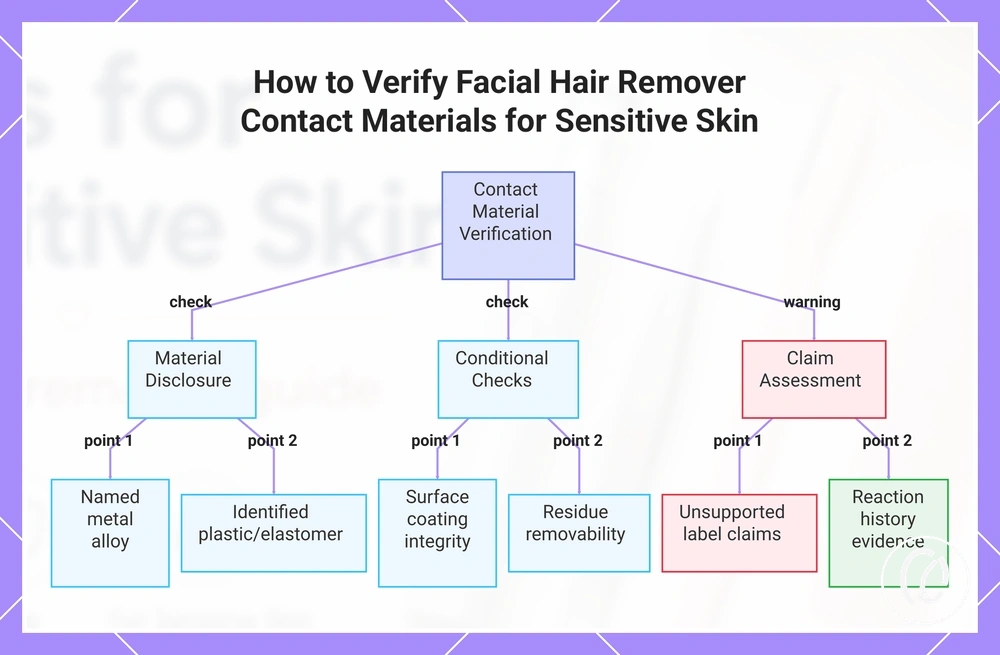
- Metal type: Confirm whether the skin-contact component is stainless steel, titanium, nickel-containing metal, or another named alloy; an unidentified alloy cannot be compared reliably with a previous metal reaction.
- Surface coating: Verify the coating material and care limits; peeling, corrosion, or exposed base metal changes the contact condition and is a stop-use signal.
- Plastic contact: Check which plastic or elastomer touches the skin and whether cleaning leaves it intact rather than cracked, tacky, or residue-retaining.
- Residue exposure: Hair, skin oil, lubricant, and cleaning product must be removable from every contact surface according to the manufacturer’s instructions.
- Claim verification: Treat “hypoallergenic,” “gentle,” “painless,” and “dermatologist-approved” as label claims unless the tested material, method, population, and result are disclosed.
- Reaction history: Stop using a material that repeatedly coincides with itching, swelling, burning, or persistent redness; formal patch testing by a dermatologist can investigate suspected allergic contact dermatitis. :contentReference[oaicite:2]{index=2}
For example, a tool that identifies a stainless-steel blade and washable plastic guard provides two materials that can be checked against a user’s reaction history, whereas a tool described only as “hypoallergenic” provides no material identity for comparison. Material disclosure does not establish that the first tool is reaction-free, but it creates a usable verification signal for the sensitive-skin decision. :contentReference[oaicite:3]{index=3}
This chart shows the key verification signals that separate useful material checks from unsupported label claims.
This chart shows the key verification signals that separate useful material checks from unsupported label claims.
Blade Guard, Head Shape, and Pressure Control
A facial hair remover is more suitable for sensitive skin when its blade guard, head shape, and pressure control reduce exposed-blade contact, keep the tool stable on facial contours, and remove visible hair without forceful pressing. A stable guard and controlled head movement can lower friction and irritation risk, but a gentle, hypoallergenic, or painless claim does not verify tool suitability without observable design and handling evidence. No universal guard gap, head width, or pressure threshold applies across all facial hair removal tools, so the model-specific instructions and the skin response remain the controlling limits.
Flexible head movement and a compact or rounded shape can improve control around the upper lip, chin, and jaw when they prevent tilting, skipping, and repeated strokes.
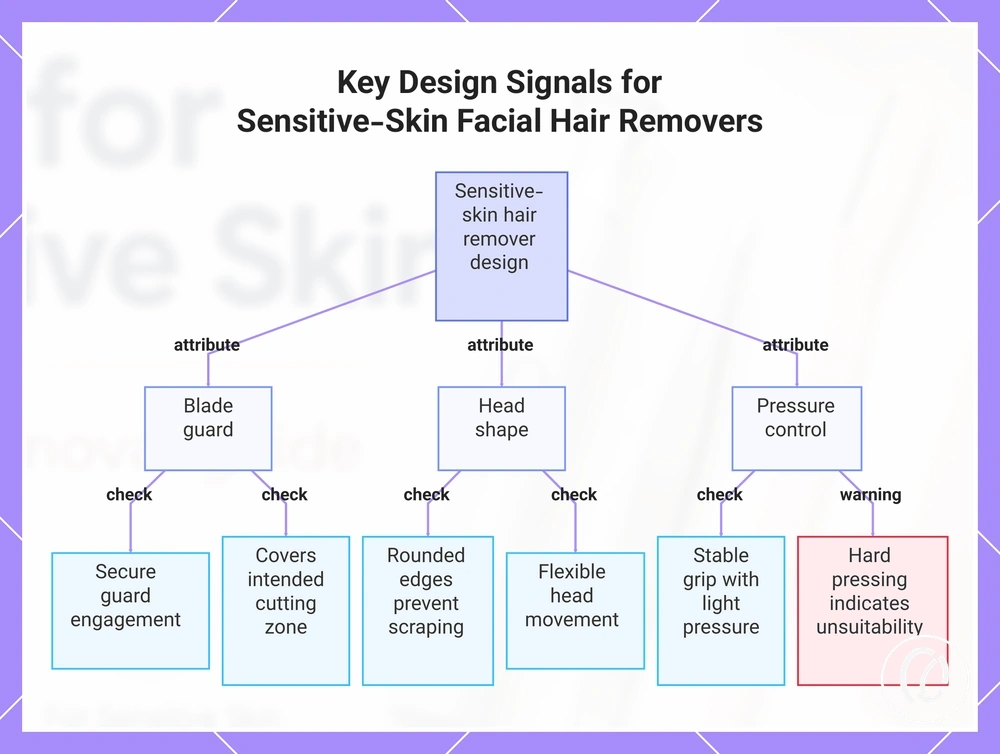
The guard should lock securely over the intended cutting area, the head should move across curved facial areas without sharp edges catching the skin, and the grip should remain stable under light pressure. Philips support documentation provides a model-specific example in which a sensitive-skin guard fits over the blade and clicks into position, showing that secure engagement is a verifiable condition rather than a general comfort promise. Flexible head movement and a compact or rounded shape can improve control around the upper lip, chin, and jaw when they prevent tilting, skipping, and repeated strokes. :contentReference[oaicite:0]{index=0}
The guard should lock securely over the intended cutting area, the head should move across curved facial areas without sharp edges catching the skin, and the grip should remain stable under light pressure.
The following design signals connect guard control, head shape, and pressure handling to lower friction:
- Blade exposure: The guard should cover the intended cutting zone and remain fixed during use; a loose, cracked, or missing guard reduces contact control.
- Rounded edges: The outer head should move across the skin without scraping, catching, or concentrating pressure at one edge.
- Flexible head movement: The head should follow facial contours while staying aligned with the skin; skipping or tilting increases the likelihood of repeated passes.
- Grip stability: The handle should remain secure with light pressure so the user does not need to squeeze harder or press the cutting head into the skin.
- Curved-area precision: A compact head should reach the upper lip, chin, and jaw without repeatedly crossing the same area.
- Pressure signal: If visible hair is removed only after harder pressing, the guard setting, head design, blade condition, or tool type is unsuitable for that use condition.
For example, suppose a rounded head clears a curved chin area in one controlled pass while a wider rigid head requires three passes. The second design creates three blade-contact events instead of one, so repeated contact becomes the clearer friction risk even though both tools use guards. This is an illustrative comparison, not a clinical threshold.
This is an illustrative comparison, not a clinical threshold.
This chart shows the three main design attributes—blade guard, head shape, and pressure control—that determine whether a facial hair remover is suitable for sensitive skin, along with specific checks for each.
Cleaning Access and Replaceable Contact Parts
Cleaning access and replaceable parts matter for sensitive-skin safety because a facial hair remover should allow hair, oil, lubricant, and other residue to be removed from every skin-contact surface, while worn components should be changed before they drag or require repeated passes. A removable head, rinse-safe contact parts, and an accessible cleaning path support hygiene; a dull edge increases friction and can raise irritation risk. These maintenance features support safer use but do not eliminate every possible skin reaction.
Cleaning and replacement conditions are model-specific.
Cleaning and replacement conditions are model-specific. Only components identified as rinse-safe in the tool instructions should be washed, while non-rinse-safe areas should be cleared with the supplied cleaning brush or another manufacturer-approved method. Replacement timing should follow the stated service limit and observable wear, with earlier replacement when a blade, foil, guard, or head shows damage, retains residue, pulls hair, or requires additional pressure.
Only components identified as rinse-safe in the tool instructions should be washed, while non-rinse-safe areas should be cleared with the supplied cleaning brush or another manufacturer-approved method.
The following checks connect hygiene and component condition to irritation risk:
- Removable head: The head should detach without leaving inaccessible residue traps and should lock securely when reattached.
- Rinse-safe parts: Wash only parts identified as washable in the model instructions; moisture in an unapproved area can damage the tool or leave residue.
- Cleaning brush: The brush should reach beneath guards, foils, and cutting teeth without bending or scratching the contact surfaces.
- Residue buildup: Visible hair, oil, lubricant, or cleaning product remaining after maintenance indicates incomplete cleaning and weakens suitability for sensitive skin.
- Dull edge: Pulling, catching, uneven cutting, or repeated passes are wear signals that increase friction.
- Replacement timing: Replace the contact part at the manufacturer’s stated limit or earlier when damage, drag, residue retention, or reduced cutting control appears.
For example, suppose a clean removable head clears an upper-lip area in one pass, while a worn head requires three passes and added pressure over the same area. The worn component creates three contact events instead of one, so replacement becomes more relevant than additional cleaning alone; this is an illustrative comparison rather than a universal replacement threshold. :contentReference[oaicite:0]{index=0}
Matching the Remover to Skin Condition, Facial Area, and Hair Type
A facial hair remover is most compatible with sensitive skin when its tool contact, removal depth, and precision match the current skin condition, facial area, and hair texture rather than relying on a single feature. According to the American Academy of Dermatology Association (AAD), shaving removes hair at the skin surface, while waxing and tweezing remove hair from the follicle, making the removal mechanism the primary compatibility criterion for irritation-prone skin. The appropriate choice therefore depends on the combination of skin state, facial area, hair type, and tolerance instead of assuming one remover fits every situation. :contentReference[oaicite:0]{index=0}
Skin condition determines how much friction or pulling the skin is likely to tolerate, while the facial area determines the precision required from the tool head.
Skin condition determines how much friction or pulling the skin is likely to tolerate, while the facial area determines the precision required from the tool head. Fine peach fuzz on the cheeks generally needs less cutting effort than coarse hair on the chin or upper lip, where repeated passes increase cumulative blade contact. The AAD recommends shaving with light pressure because unnecessary pressure increases skin irritation, although it does not specify one pressure value that applies to every facial hair removal tool. :contentReference[oaicite:1]{index=1}
The comparison below organises the main compatibility conditions that influence irritation risk for sensitive facial skin.
The comparison below organises the main compatibility conditions that influence irritation risk for sensitive facial skin.
| Entity/part | Attribute/criterion | Value/condition | Effect/risk/decision |
|---|---|---|---|
| Sensitive skin | Skin state | Skin barrier is intact with no active cuts, dermatitis, or visible inflammation. | Surface-cutting tools are generally a better compatibility match than root-removal methods because they avoid follicle traction. |
| Upper lip | Facial area | Small treatment area requiring precise tool-head control. | A compact head can reduce repeated passes and improve small-area precision. |
| Chin | Hair texture | Coarse hair typically requires greater cutting effort than fine peach fuzz. | If repeated passes become necessary, friction increases and a different cutting method may provide a better compatibility match. |
| Cheeks | Hair type | Fine peach fuzz with limited cutting resistance. | Light surface trimming is often sufficient without introducing root pulling. |
| Hair removal tool | Removal depth | Surface cutting or root removal. | Surface cutting reduces pulling force, while root removal increases follicle traction and may not suit reactive skin. |
| User tolerance | Comfort response | Individual response to friction, pressure, and pulling during use. | Persistent redness, burning, or discomfort after correct use indicates the current remover is not the most compatible option for that skin condition. |
For example, suppose a person has sensitive skin, coarse chin hair, and fine peach fuzz on the cheeks. Using a guarded trimmer for the cheeks and a closer surface-cutting tool for the chin that removes visible hair in one pass instead of three reduces total blade-contact events, making the comparison based on friction exposure rather than hair-removal closeness. This is an illustrative compatibility example rather than a clinical threshold. :contentReference[oaicite:2]{index=2}
Small-area Precision for Upper Lip, Chin, and Cheeks
A facial hair remover is most compatible with sensitive skin when its tool head size and tool contact match the specific facial area and hair texture. The upper lip benefits from the greatest small-area precision because of its narrow contour, the chin commonly combines curved skin with coarse hair, and the cheeks usually contain finer peach fuzz across a broader surface. Matching the tool to these local conditions helps reduce unnecessary passes, which is the practical compatibility decision within the sensitive-skin context. :contentReference[oaicite:0]{index=0}
A facial hair remover is most compatible with sensitive skin when its tool head size and tool contact match the specific facial area and hair texture .
The comparison below shows how precision requirements change across each facial area according to local compatibility variables rather than applying one approach to every part of the face.
| Entity/part | Attribute/criterion | Value/condition | Effect/risk/decision |
|---|---|---|---|
| Upper lip | Tool head size and control requirement | Small facial area with visible hair close to the lip border and limited working space. | A compact tool head improves small-area precision and can reduce repeated tool contact on sensitive skin. |
| Chin | Hair texture and facial contour | Curved facial area where coarse hair often offers greater cutting resistance than peach fuzz. | A tool that maintains stable contact across the curve can reduce repeated passes and unnecessary friction. |
| Cheeks | Hair visibility and skin coverage | Peach fuzz is typically finer and spread across a wider facial area with fewer contour changes. | A controlled wider stroke may remove visible hair efficiently when light pressure maintains comfortable tool contact. |
For example, suppose a compact tool head removes visible hair from the upper lip in 1 pass, while a wider head requires 3 overlapping passes to reach the same narrow border. This illustrative comparison creates three tool-contact events instead of one, increasing cumulative friction on delicate skin even though the cutting method remains unchanged. :contentReference[oaicite:1]{index=1}
Fine Hair, Coarse Hair, and Peach Fuzz Sensitivity Trade-offs
A facial hair remover is most compatible with sensitive skin when its tool contact, required closeness, and pulling force match the user's hair texture and facial area. Peach fuzz, fine hair, and coarse hair create different cutting resistance and friction conditions, so the gentlest option does not always produce the closest finish. The practical decision is to minimise unnecessary passes while achieving the required visible hair removal for the upper lip, chin, or cheeks. :contentReference[oaicite:0]{index=0}
The practical decision is to minimise unnecessary passes while achieving the required visible hair removal for the upper lip, chin, or cheeks.
The comparison below shows how hair texture changes comfort and suitability for sensitive skin without assuming one facial hair removal tool performs equally well across every hair type.
| Entity/part | Attribute/criterion | Value/condition | Effect/risk/decision |
|---|---|---|---|
| Peach fuzz on cheeks | Hair texture and required closeness | Fine, lightly visible hair that usually requires only surface cutting with limited tool contact. | Fewer passes are typically needed, reducing cumulative friction on sensitive skin. |
| Fine hair on upper lip | Facial area and tool precision | Fine hair in a narrow treatment area where a compact tool head provides more controlled contact. | Improved small-area precision can reduce repeated passes close to delicate skin. |
| Coarse hair on chin | Hair texture and pulling force | Thicker hair creates greater cutting resistance and may require additional passes if the cutting edge loses efficiency. | Repeated passes or increased pressure increase friction, so another removal method may provide a better compatibility match. |
For example, suppose peach fuzz on the cheeks is removed in 1 controlled pass, while coarse hair on the chin requires 3 passes with the same facial hair remover. This hypothetical comparison creates three tool-contact events instead of one, increasing cumulative friction on the chin even though the removal method remains unchanged. The example illustrates why matching hair texture to the appropriate level of closeness is often more important than pursuing the closest possible finish on every facial area. :contentReference[oaicite:1]{index=1}
Claims That Need Qualification on Sensitive Skin
A painless claim, gentle claim, hypoallergenic, dermatologist-approved, safe for sensitive skin, or irritation-free label is a conditional signal, not proof that a facial hair remover will suit every person with sensitive skin. The useful criterion is whether the claim identifies a test method, contact material, tool feature, use condition, or limitation that can be checked against the user’s reaction history. Claim wording without that supporting detail has limited verification value. :contentReference[oaicite:0]{index=0}
Claim wording without that supporting detail has limited verification value.
The U.S. Food and Drug Administration states that “hypoallergenic” has no federally defined standard in cosmetic labelling, so the term does not by itself prove a lower reaction risk. A dermatologist-approved claim is more useful when it identifies who performed the assessment, what was evaluated, and under which conditions. A painless or gentle claim must still be interpreted against pressure, hair texture, pulling force, tool contact, and individual tolerance, while previous reactions and dermatologist-directed patch testing provide more personal evidence about suspected contact sensitivity.
The table separates each claim’s possible meaning from the verification needed before it changes a sensitive-skin decision.
The table separates each claim’s possible meaning from the verification needed before it changes a sensitive-skin decision.
| Entity/part | Attribute/criterion | Value/condition | Effect/risk/decision |
|---|---|---|---|
| Painless claim | Comfort outcome | Valid only for the stated tool, method, body area, and test conditions; individual pain tolerance remains unspecified unless disclosed. | Treat the claim as incomplete when pressure, hair texture, pulling force, and participant conditions are not identified. |
| Gentle claim | Design support | Useful when linked to a verifiable feature such as guarded blade contact, reduced pulling, controlled pressure, or fewer repeated passes. | Compare the stated feature with the intended facial area instead of relying on the adjective alone. |
| Hypoallergenic | Contact-material evidence | No universal reaction-free outcome is established by the label; named metals, coatings, plastics, and cleaning residues remain the relevant values. | Check disclosed materials against reaction history and stop use if itching, swelling, burning, or persistent redness occurs. |
| Dermatologist-approved | Assessment transparency | Verification requires the evaluator, method, population, contact duration, and result to be identified. | Without those details, the wording provides limited evidence about suitability for a specific user. |
| Safe for sensitive skin | Use-condition boundary | Suitability remains conditional on intact skin, correct pressure, clean contact parts, and use within the manufacturer’s instructions. | Active irritation, broken skin, or a known material reaction overrides the general label claim. |
| Irritation-free | Outcome certainty | The wording does not account for every skin condition, hair texture, pressure level, or reaction history. | Do not treat it as a guaranteed outcome; recurring redness, burning, or swelling is a stop-use signal. |
For example, suppose two facial hair removers both carry a gentle claim, but only one identifies a guarded head, named contact materials, and the intended facial area. The second claim provides three verifiable conditions, while the first provides none, so it offers stronger decision support without proving that irritation cannot occur.
Painless Claims and a Realistic Comfort Range
A painless claim describes intended comfort positioning, not a guaranteed experience for every person with sensitive skin. The realistic comfort range is conditional: a facial hair remover is more likely to feel tolerable when its tool mechanism, pressure, hair texture, skin condition, and repeated passes remain within the user’s pain tolerance. This makes observed response and verification more useful than the label claim alone. :contentReference[oaicite:0]{index=0}
This makes observed response and verification more useful than the label claim alone.
Surface cutting avoids the follicle-pulling force of waxing, tweezing, and epilation, but it can still become uncomfortable when coarse hair increases cutting resistance, active irritation changes skin sensitivity, or repeated passes increase tool contact. A gentle claim, hypoallergenic label, or dermatologist-approved statement does not define an individual comfort result unless the contact material, test conditions, intended use, and participant group are disclosed. Previous reaction history and the user’s response during patch testing remain the practical limits.
The comparison below shows how local conditions change the meaning of a painless claim.
The comparison below shows how local conditions change the meaning of a painless claim.
| Entity/part | Attribute/criterion | Value/condition | Effect/risk/decision |
|---|---|---|---|
| Tool mechanism | Pulling force | Surface cutting removes the hair shaft without extracting the follicle; waxing, tweezing, and epilation remove hair from the root. | Root removal creates direct pulling, so a painless claim requires separate verification for users with limited pulling tolerance. |
| Hair texture | Cutting resistance | Fine hair and peach fuzz offer less cutting resistance than coarse hair under the same tool condition. | Coarse hair can require extra pressure or repeated passes when the cutting head is inefficient, increasing discomfort risk. |
| Skin condition | Current sensitivity | Calm, intact skin is the suitable test condition; broken, inflamed, or already stinging skin is not. | Existing irritation outweighs the comfort claim and supports postponing use. |
| User technique | Pressure and repeated passes | Light pressure with one controlled pass creates less cumulative tool contact than forceful pressure with overlapping strokes. | Rising discomfort after extra passes indicates that the claimed comfort range has been exceeded for that use condition. |
| User tolerance | Pain response | Tolerance is individual and is not established by painless, gentle, hypoallergenic, or dermatologist-approved wording. | The user’s observed response provides the controlling decision signal. |
For example, suppose a patch test causes no discomfort after 1 light pass but produces stinging after 3 overlapping passes. This hypothetical comparison shows that repeated tool contact can change the comfort result even when the remover carries a painless claim. Discomfort during patch testing should outweigh the marketing language and act as a stop-use signal.
Dermatologist-approved and Hypoallergenic Claim Limits
A dermatologist-approved or hypoallergenic claim is a limited proof signal for a facial hair remover, not medical advice, formal certification, or guaranteed compatibility with sensitive skin. The claim has greater verification value only when its source, contact materials, testing scope, and intended population are disclosed. The user’s reaction history and observed skin response remain the final compatibility boundaries. :contentReference[oaicite:0]{index=0}
The user’s reaction history and observed skin response remain the final compatibility boundaries.
The U.S. Food and Drug Administration states that “hypoallergenic” has no federal standard or definition and does not require cosmetic manufacturers to submit evidence supporting the claim before marketing. A dermatologist-approved statement remains limited when it does not identify the dermatologist’s role, assessment method, participant group, tested facial area, contact material, or recorded result. A legitimate evaluation can therefore support a label claim without proving that the same facial hair remover will suit a particular user.
The checklist below helps verify the claim source, material disclosure, sensitive-skin relevance, testing scope, and individual response.
The checklist below helps verify the claim source, material disclosure, sensitive-skin relevance, testing scope, and individual response.
- Claim source: Identify whether the statement comes from the manufacturer, an independent laboratory, or a named dermatologist, and confirm the evaluator’s role.
- Material disclosure: Check whether the blade, foil, coating, plastic, lubricant, and other skin-contact materials are named rather than relying on the word hypoallergenic alone.
- Sensitive-skin relevance: Verify whether the tested participants were specifically described as having sensitive skin; an unspecified participant group does not establish that condition.
- Testing scope: Look for the participant count, facial area, contact duration, use method, comparison condition, and recorded reactions; missing details limit what the claim demonstrates.
- Claim distinction: Treat a gentle claim or painless claim as evidence about intended comfort only when the pressure, hair texture, tool mechanism, and tolerance conditions are defined.
- Reaction history: Compare the disclosed materials and test conditions with previous redness, itching, burning, or swelling, and give the personal response greater weight than the label.
For example, suppose a facial hair remover names one dermatologist but does not disclose the participant count, contact materials, facial area, or reaction criteria. The claim provides one identifiable source while leaving four decision conditions unspecified, so it cannot establish individual compatibility. Personal irritation during cautious patch testing should outweigh the marketing language even when the underlying claim is legitimate.
Safe Use Conditions That Reduce Irritation
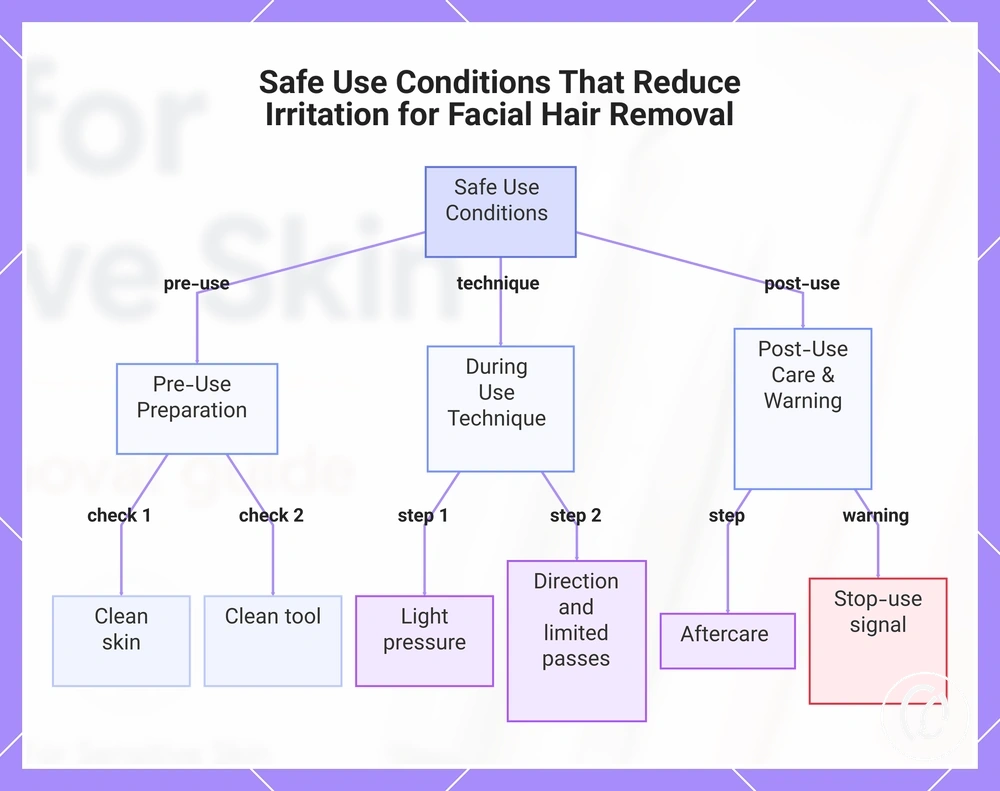
A facial hair removal tool is less likely to increase irritation on sensitive skin when it is used on clean skin, with a clean tool, light pressure, limited passes, and appropriate aftercare. These conditions reduce avoidable friction and contamination but cannot guarantee that irritation will not occur because skin response also depends on the user's skin condition, hair texture, and tool design. This section focuses on the practical conditions that help lower irritation risk during routine use. :contentReference[oaicite:0]{index=0}
This section focuses on the practical conditions that help lower irritation risk during routine use.
According to the American Academy of Dermatology Association, shaving in the direction of hair growth, using light pressure, rinsing the blade after each stroke, and replacing a manual razor blade after approximately 5 to 7 shaves can help reduce razor burn and irritation. That replacement interval applies to conventional manual razor blades rather than every electric trimmer, foil shaver, or dermaplaning tool, so manufacturer maintenance instructions remain the controlling requirement for those products. Home patch testing should be limited to checking individual tolerance on a small area, while formal allergy patch testing is a dermatologist-supervised diagnostic procedure. :contentReference[oaicite:1]{index=1}
The checklist below summarises the main safe-use conditions that reduce unnecessary friction and help identify a stop-use signal .
The checklist below summarises the main safe-use conditions that reduce unnecessary friction and help identify a stop-use signal.
- Clean skin: Remove makeup, sunscreen, oil, and visible debris before hair removal, and avoid using the tool on broken, inflamed, or infected skin.
- Patch testing: Test the facial hair removal tool on a small discreet area before full use. Burning, swelling, persistent itching, or unusual redness after the test is a stop-use signal.
- Clean tool contact: Remove trapped hair and residue from the blade, foil, guard, or cutting head according to the manufacturer's cleaning instructions before each session.
- Light pressure: Allow the cutting head to contact the hair without pressing it firmly into the skin because excess pressure increases friction rather than improving suitability.
- Direction and limited passes: Move shaving tools with the direction of hair growth where appropriate and avoid repeated overlapping strokes once visible hair has been removed.
- Aftercare: Apply a calming skincare product that the skin already tolerates and minimise unnecessary heat, vigorous rubbing, or prolonged sun exposure while temporary redness settles.
For example, suppose visible facial hair is removed with 1 light pass, but 3 overlapping passes over the same area produce burning and increasing redness. This hypothetical comparison illustrates that cumulative tool contact, rather than hair removal alone, can trigger unnecessary irritation and should be treated as a reason to stop the session. If burning, prolonged redness, swelling, or another unusual reaction develops, discontinue use and follow the detailed guidance in safe use before and after removal before using the tool again. :contentReference[oaicite:2]{index=2}
For example, suppose visible facial hair is removed with 1 light pass , but 3 overlapping passes over the same area produce burning and increasing redness.
This chart outlines the key safe-use conditions that reduce irritation during facial hair removal, covering pre-use preparation, technique, and post-care with a warning signal.
Patch Testing and Clean-Skin Preparation
Patch testing and clean-skin preparation reduce avoidable reaction risk by checking how sensitive skin responds to a facial hair removal tool before full facial use. A suitable patch test begins on clean skin with a clean tool, uses light pressure and limited passes on one small test area, and is followed by a reaction check before wider facial use. No universally accepted home waiting period exists for facial hair removal tools, so the observation period should follow the manufacturer's instructions when available or continue until the tested area can be checked for unexpected burning, persistent redness, swelling, or itching. :contentReference[oaicite:0]{index=0}
The following steps reduce unnecessary friction and help identify a stop-use signal before treating the full face.
The following steps reduce unnecessary friction and help identify a stop-use signal before treating the full face.
- Choose a small test area: Test one discreet facial area using the same tool, contact surface, and technique planned for full use.
- Prepare clean skin and a clean tool: Remove makeup, sunscreen, oil, and visible residue, and ensure the blade, foil, guard, or cutting head is free of trapped hair and debris.
- Use light pressure and limited passes: Complete the test with gentle contact rather than repeated overlapping strokes, because additional friction can change the skin response.
- Allow an observation period: Wait long enough to perform a careful reaction check instead of relying on a fixed time, because no standard home waiting period has been established for this purpose.
- Check for a reaction: Burning, persistent redness, swelling, itching, or another unusual response is a stop-use signal and should end further facial use until the cause is understood.
- Apply aftercare: If the test area remains comfortable, use a calming step that the skin already tolerates before proceeding with the rest of the face.
For example, suppose one small test area is treated with 1 light pass and remains comfortable, while a second pass over the same area produces burning and visible redness. This hypothetical comparison shows that repeated tool contact can change the skin response even when the same facial hair removal tool is used. If the skin has been recently irritated or is being treated with active skincare ingredients such as retinoids or exfoliating acids, delaying facial hair removal until the skin barrier feels calm provides a safer preparation condition than testing immediately. :contentReference[oaicite:1]{index=1}
Pressure, Direction, and Frequency of Use
Pressure, direction, and frequency of use influence sensitive-skin comfort by controlling cumulative friction during facial hair removal. According to the American Academy of Dermatology Association, using light pressure, shaving in the direction of hair growth, and avoiding repeated strokes over the same area can help reduce razor burn and skin irritation. No evidence-based guideline specifies a universal interval between facial hair removal sessions because appropriate spacing depends on skin recovery, hair growth, tool type, and individual skin response. :contentReference[oaicite:0]{index=0}
Pressure , direction , and frequency of use influence sensitive-skin comfort by controlling cumulative friction during facial hair removal.
The following technique checks help minimise unnecessary skin contact while keeping the focus on friction control rather than maximum hair removal.
- Light pressure: Allow the cutting head to glide over clean skin without pressing it into the surface, because extra pressure increases friction without improving compatibility.
- Short strokes and limited passes: Remove visible hair with short controlled movements and limited passes. If repeated overlapping strokes are needed, the tool, hair type, or technique should be reassessed instead of applying more pressure.
- Tool angle and hair-growth direction: Hold the facial hair removal tool at the angle recommended by its manufacturer and, for shaving tools, begin by moving in the direction of hair growth to reduce unnecessary skin contact.
- Spacing between sessions: Perform the next session only after the skin has recovered from the previous one. There is no fixed waiting time because recovery differs according to skin condition, hair growth, and removal method.
- Reaction check and aftercare: Begin with patch testing when using a new tool, apply appropriate aftercare, and treat persistent redness, burning, swelling, or itching as a stop-use signal.
For example, suppose visible facial hair is removed with 1 light pass, but 3 overlapping passes are required over the same area because coarse hair is not being cut efficiently. This hypothetical comparison shows that tripling the number of passes also triples skin-contact events, increasing cumulative friction and indicating that the facial hair removal tool, hair texture, or technique may not be well matched rather than that more pressure is needed. :contentReference[oaicite:1]{index=1}
Post-removal Calming and Sun-sensitivity Limits
Post-removal calming supports sensitive skin by reducing additional friction and environmental irritation after facial hair removal rather than preventing every skin reaction. According to the American Academy of Dermatology Association, applying a fragrance-free moisturizer after shaving can help restore the skin barrier, while protecting recently treated skin from ultraviolet exposure becomes more important if temporary redness or irritation is present. These measures are a limited aftercare step that supports the safe-use conditions established during hair removal instead of replacing them. :contentReference[oaicite:0]{index=0}
The checklist below helps protect recently treated skin after facial hair removal.
The checklist below helps protect recently treated skin after facial hair removal.
- Do: Apply a soothing, fragrance-free moisturizer to clean skin after hair removal if the skin feels dry, tight, or mildly uncomfortable.
- Avoid: Fragranced skincare products and active ingredients such as retinoids or exfoliating acids until the skin feels comfortable again, because recently treated skin can react more easily.
- Avoid: Hot showers, steam rooms, saunas, or other unnecessary heat exposure while visible redness is present because heat can increase flushing.
- Do: Limit direct sun exposure and use appropriate sun protection if treated skin will be outdoors, as freshly treated skin may be temporarily more sensitive to ultraviolet light.
- Do: Continue a reaction check after patch testing, light pressure, and limited passes. Persistent redness, burning, swelling, or itching is a stop-use signal rather than a normal aftercare response.
For example, suppose facial hair is removed with 1 light pass and the skin shows mild redness that settles after a calming moisturizer is applied. If burning, swelling, or redness persists into the following day or becomes more noticeable after heat or sun exposure, that hypothetical pattern falls outside routine post-removal calming and should be treated as a troubleshooting issue instead of normal aftercare. :contentReference[oaicite:1]{index=1}
When a Facial Hair Removal Tool May Not Be the Safest Option
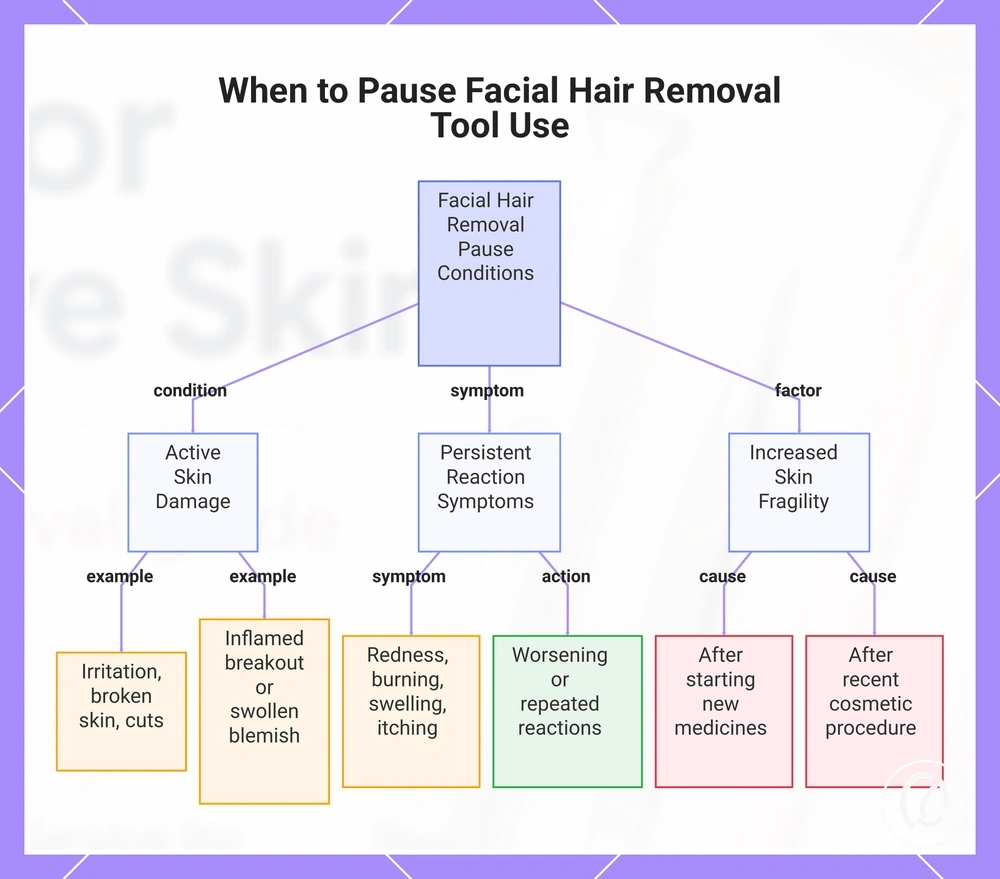
A facial hair removal tool should be paused when the skin condition has moved beyond routine sensitivity into a higher-risk state such as active irritation, broken skin, an inflamed breakout, or a recent reaction with persistent redness, burning, or swelling. These conditions increase irritation risk because additional tool contact adds friction to skin that is already compromised. The decision point for this section is to recognise when delaying hair removal is safer than continuing with routine use. :contentReference[oaicite:0]{index=0}
The decision point for this section is to recognise when delaying hair removal is safer than continuing with routine use.
Normal temporary sensitivity after careful facial hair removal is different from a reaction that persists or becomes worse. A facial hair removal tool should also be reconsidered when the skin has become more fragile after starting medicines known to increase skin sensitivity or following a recent cosmetic procedure, because these situations change the skin's tolerance to mechanical contact. These are pause conditions rather than evidence that facial hair removal tools are unsafe for every person with sensitive skin. Persistent symptoms that do not improve should be treated as a medical concern requiring professional advice instead of continued self-testing. :contentReference[oaicite:1]{index=1}
Normal temporary sensitivity after careful facial hair removal is different from a reaction that persists or becomes worse.
The checklist below separates routine post-removal sensitivity from skin conditions where delaying or avoiding tool use is the safer decision.
- Pause use: Active irritation is already present, including ongoing burning, stinging, or discomfort before the tool touches the skin.
- Pause use: Broken skin, open cuts, abrasions, or skin that has not fully healed are present because additional tool contact increases friction.
- Pause use: An inflamed breakout, swollen blemish, or visibly irritated patch lies within the planned treatment area.
- Pause use: Persistent redness, burning, swelling, or itching continues after a previous facial hair removal session instead of settling during normal recovery.
- Pause use: The skin has become unusually sensitive after starting a medicine or following a recent skin procedure until recovery or professional advice confirms that hair removal can safely resume.
- Seek professional advice: Ongoing burning, swelling, worsening discomfort, or repeated reactions despite careful technique should be treated as a medical concern rather than normal sensitive-skin behaviour.
For example, suppose one small patch test is completed with 1 light pass, but the same area still shows burning and persistent redness the following day. This hypothetical example indicates a reaction concern rather than routine post-removal sensitivity, so continuing with full-face hair removal is not the safer choice. If symptoms continue after the skin has been allowed to recover, review facial hair removal irritation fixes before using the tool again or seek professional advice if the reaction persists. :contentReference[oaicite:2]{index=2}
For example, suppose one small patch test is completed with 1 light pass , but the same area still shows burning and persistent redness the following day.
This chart shows the key skin conditions and factors that indicate when facial hair removal should be delayed, including active damage, persistent reactions, and increased sensitivity from external causes.
Active Irritation, Breakouts, or Damaged Skin
Active irritation, broken skin, or an inflamed breakout changes the safety decision because a facial hair removal tool adds direct contact and friction to already compromised skin. Pause use when the treatment area shows open skin, swelling, painful bumps, burning, or persistent redness. These findings define a higher-risk skin state rather than routine sensitivity. :contentReference[oaicite:0]{index=0}
These findings define a higher-risk skin state rather than routine sensitivity.
The warning signs below identify pause conditions in which continued removal can increase discomfort or make a visible reaction more pronounced.
- Persistent redness: Redness that remains, spreads, or becomes more noticeable before the next session is a pause condition.
- Swelling: Visible swelling in the planned treatment area indicates that further tool contact should be avoided.
- Broken skin: Cuts, abrasions, picked spots, or other open areas should not be crossed with a blade, foil, guard, or trimming head.
- Painful bumps: Tender raised areas increase the likelihood of repeated pressure, catching, or direct contact on the same spot.
- Inflamed breakout: Red, swollen, or painful acne within the treatment area is a reason to pause use rather than remove hair over it.
- Recent reaction: Burning, swelling, itching, or persistent redness after a previous session is a reaction concern; continued or worsening symptoms may become a medical concern that warrants professional advice.
For example, suppose a small area contains 1 open spot and 2 painful inflamed bumps. Passing the facial hair removal tool across all 3 compromised areas would create repeated contact where the skin barrier is already disrupted, so the safer decision is to avoid that area rather than continue with one or more passes. Continuing removal over damaged skin can increase discomfort or visible reaction risk, while persistent burning, swelling, or worsening redness should end further self-testing. :contentReference[oaicite:1]{index=1}
Persistent Reactions or Medical Skin Concerns
Persistent reactions after using a facial hair removal tool should move the decision beyond tool selection and toward professional advice before further use. A reaction becomes a medical concern when persistent redness, burning, swelling, recurring bumps, or worsening skin changes continue after normal recovery or repeatedly return despite careful technique. In these circumstances, pause use because further tool contact can increase irritation risk rather than improve the outcome. :contentReference[oaicite:0]{index=0}
The conditions below indicate that continued self-testing is no longer the appropriate decision.
The conditions below indicate that continued self-testing is no longer the appropriate decision.
- Persistent redness: Redness that remains, repeatedly returns, or becomes more noticeable after successive hair-removal sessions is a reaction concern.
- Burning or swelling: Burning sensations or visible swelling that continue after use indicate that additional tool contact may increase discomfort and justify professional advice.
- Recurring bumps: Painful bumps or repeated inflamed areas developing after multiple facial hair removal sessions suggest that repeating the same approach is unlikely to improve the result.
- Known skin disorders: Eczema, psoriasis, rosacea, or other diagnosed skin disorders can change skin tolerance and should be considered before resuming facial hair removal.
- Medication-related sensitivity: Medicines that increase skin sensitivity, including some retinoids or acne treatments, can make routine tool contact less suitable until appropriate medical guidance is obtained.
- Active irritation or broken skin: An inflamed breakout, broken skin, or ongoing active irritation is a clear reason to pause use until the skin condition has been assessed.
For example, suppose a user completes 3 separate facial hair removal sessions using light pressure and limited passes, yet the same area develops burning, persistent redness, and recurring bumps after each session. This hypothetical pattern indicates that changing to another facial hair removal tool alone is unlikely to address the underlying reaction and that professional assessment is the safer next step. This guidance supports tool decision-making and should not be interpreted as a clinical evaluation. :contentReference[oaicite:1]{index=1}
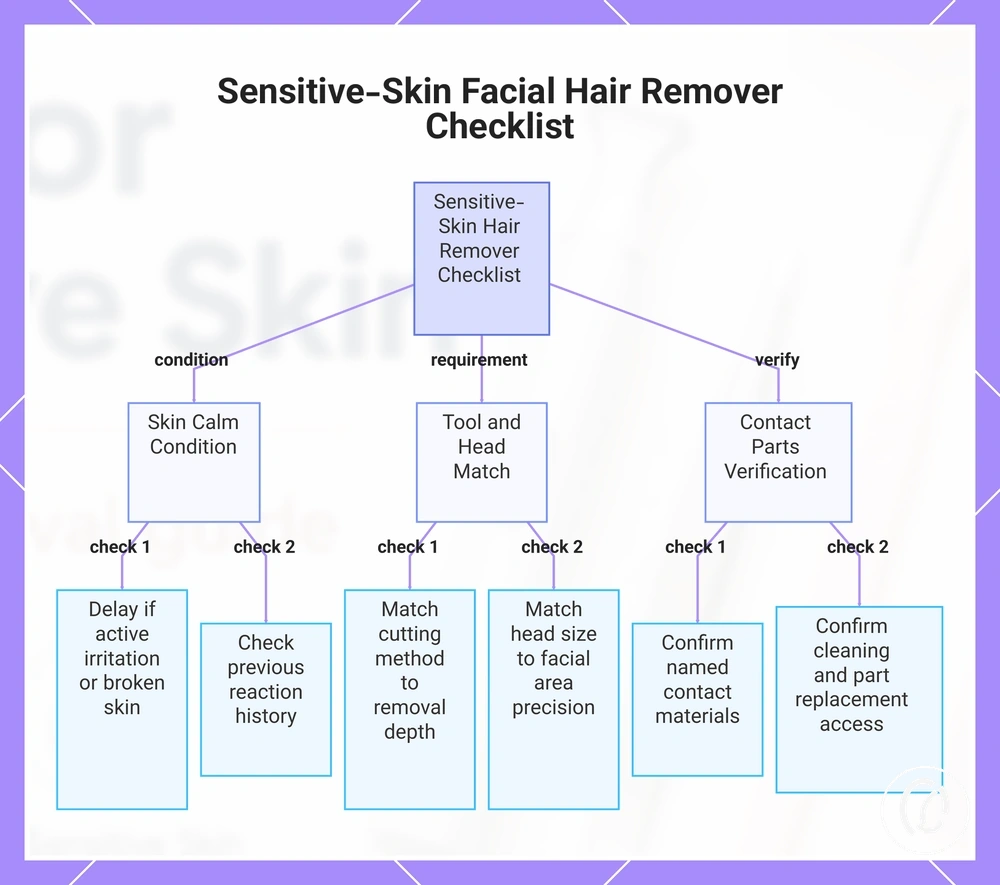
Sensitive-skin Facial Hair Remover Checklist
A sensitive-skin facial hair remover should match the user’s skin condition, hair texture, facial area, and removal need while limiting unnecessary friction or pulling. This checklist verifies irritation risk, tool fit, feature evidence, maintenance access, and safe-use conditions rather than relying on comfort claims alone. :contentReference[oaicite:0]{index=0}
Organise the final decision into four groups: irritation risk, physical fit, feature proof, and use conditions.
Organise the final decision into four groups: irritation risk, physical fit, feature proof, and use conditions. Irritation risk covers the current skin condition and previous reactions; physical fit covers tool type, hair texture, and facial area; feature proof covers contact material, guard design, and cleaning access. The broader selection criteria for facial hair removal tools can support comparison, but sensitive-skin suitability still requires individual verification through skin response and safe technique. :contentReference[oaicite:1]{index=1}
Use the following safety checklist before choosing or using a facial hair removal tool.
Use the following safety checklist before choosing or using a facial hair removal tool.
- Tool type and skin condition: Prefer surface cutting when reduced pulling is the priority, and delay use when active irritation, broken skin, an inflamed breakout, or an unresolved reaction is present.
- Hair texture and facial area: Match the cutting method and head size to fine peach fuzz, coarse hair, and the precision required around the upper lip, chin, or cheeks.
- Contact material and guard design: Confirm the named skin-contact materials, compare them with previous reactions, and verify that the guard is intact, securely fitted, and free from exposed sharp edges.
- Cleaning access: Confirm that hair and residue can be removed from every contact surface and that worn blades, foils, guards, or heads can be replaced according to the manufacturer’s instructions.
- Comfort-claim verification: Treat painless, gentle, hypoallergenic, dermatologist-approved, and sensitive-skin wording as conditional unless the tested feature, material, method, population, and result are disclosed.
- Patch testing and technique: Complete patch testing on a small area, then use light pressure and limited passes only when the test area remains comfortable.
- Stop-use signal: Stop when burning, swelling, persistent redness, itching, broken skin, or recurring painful bumps appear, and seek professional advice when a reaction persists or worsens.
A completed checklist should produce explicit matches rather than a total score: the tool type must suit the required removal depth, the head must suit the facial area, the contact parts must be identifiable and maintainable, and the skin must be calm enough for use. A failed safety condition, such as broken skin or a repeated reaction, outweighs otherwise suitable features and should pause the decision.
A failed safety condition, such as broken skin or a repeated reaction, outweighs otherwise suitable features and should pause the decision.
The safest conditional choice is the facial hair removal tool that matches the reader’s current skin condition and removal need while creating the least unnecessary friction or pulling. When two tools meet the same removal need, prefer the option that requires fewer passes, provides more controlled contact, and offers clearer evidence for its materials, guard, cleaning access, and comfort claims.
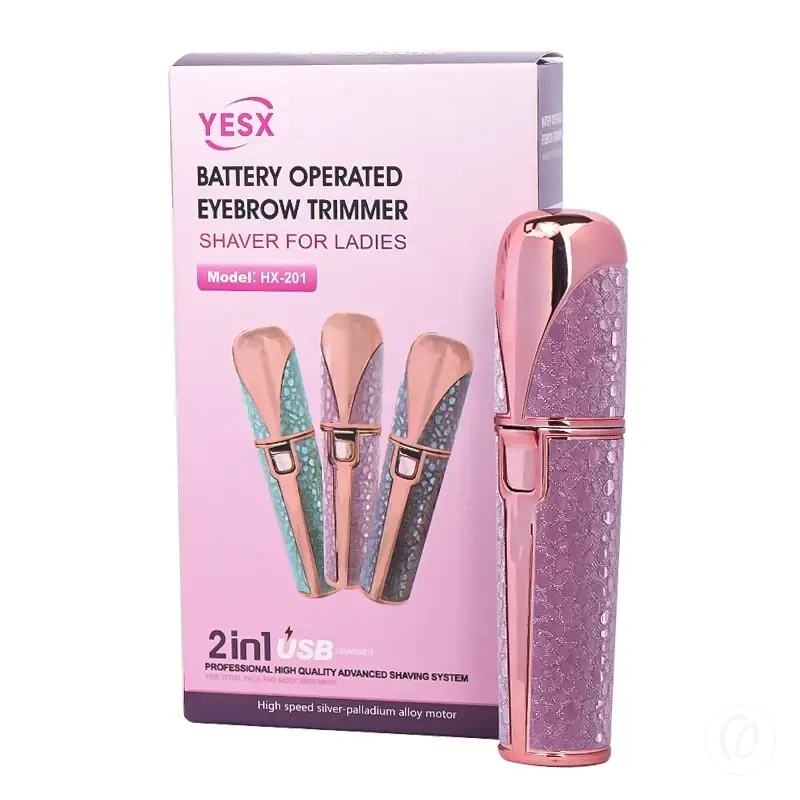
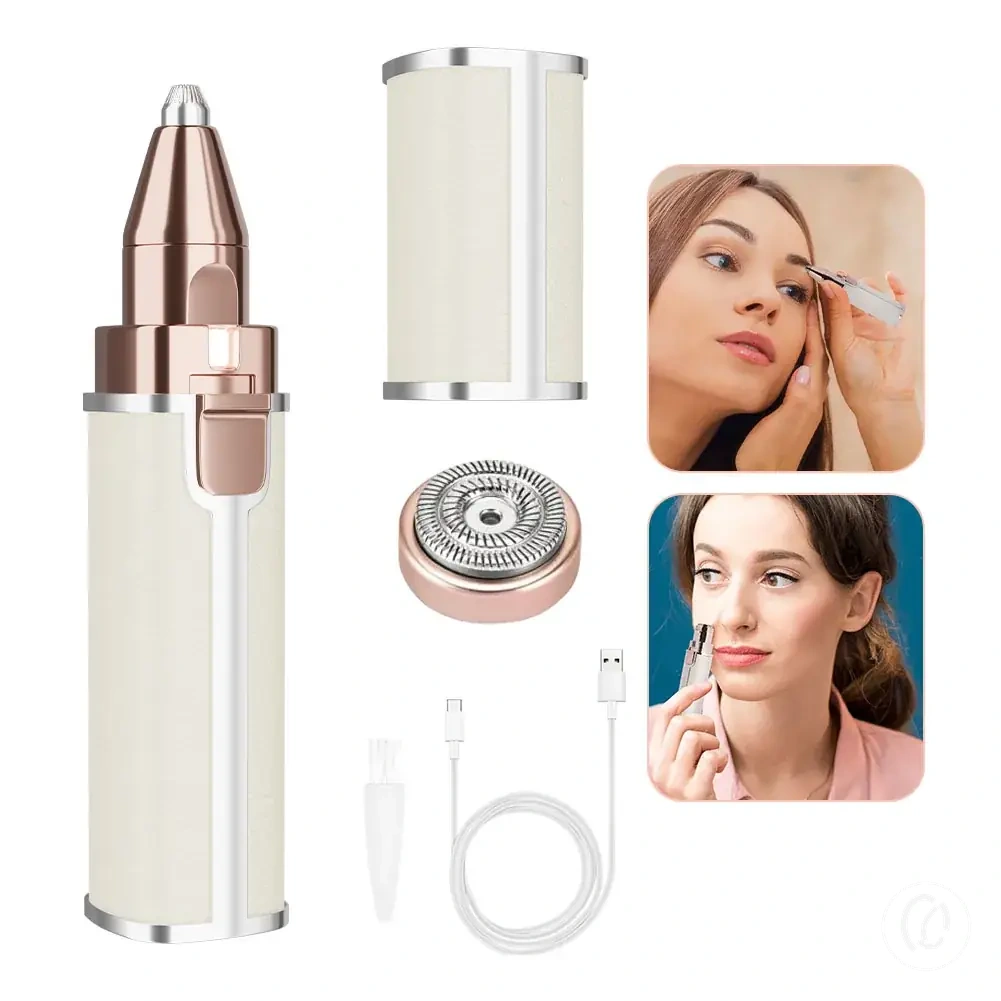
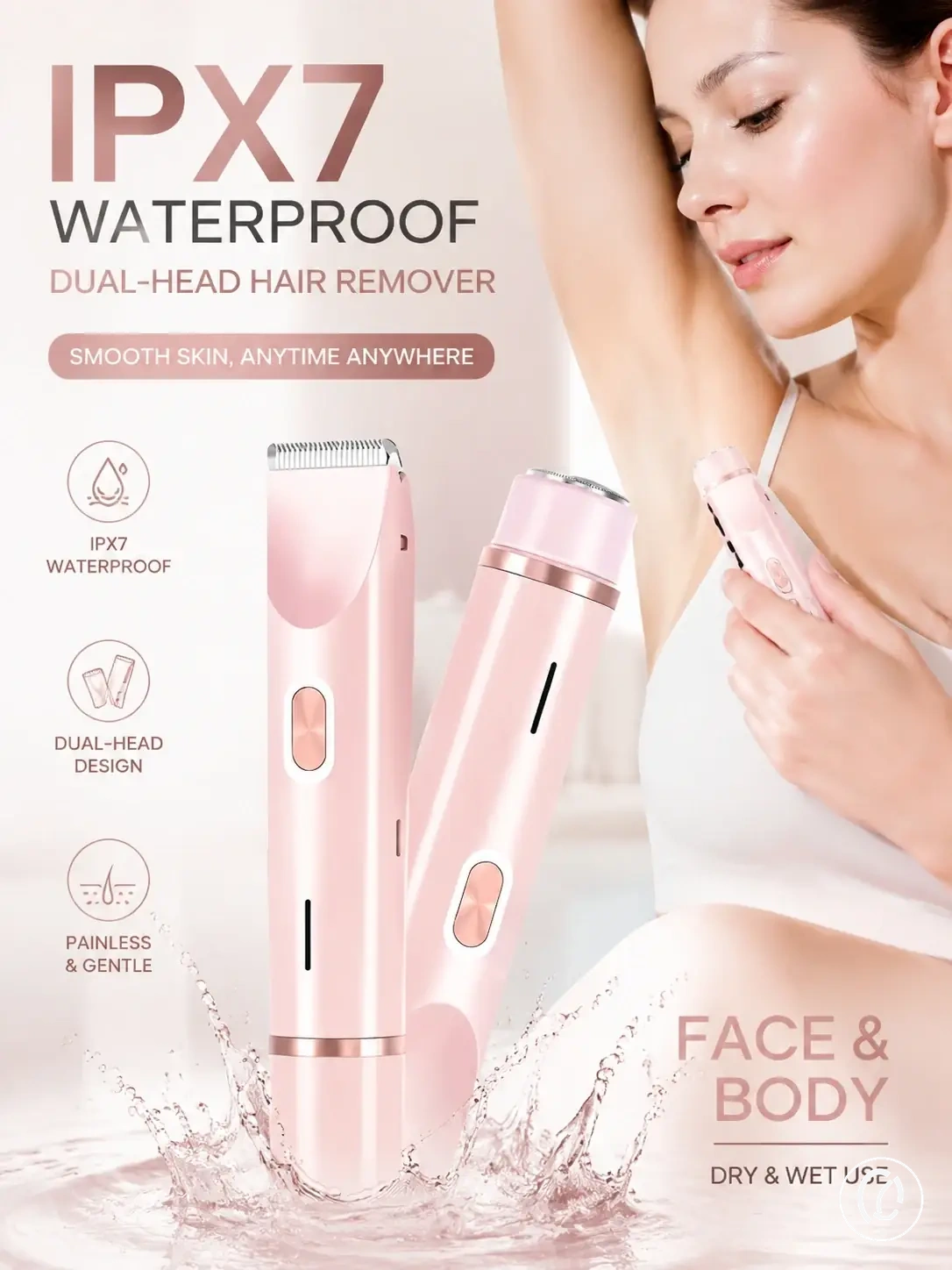
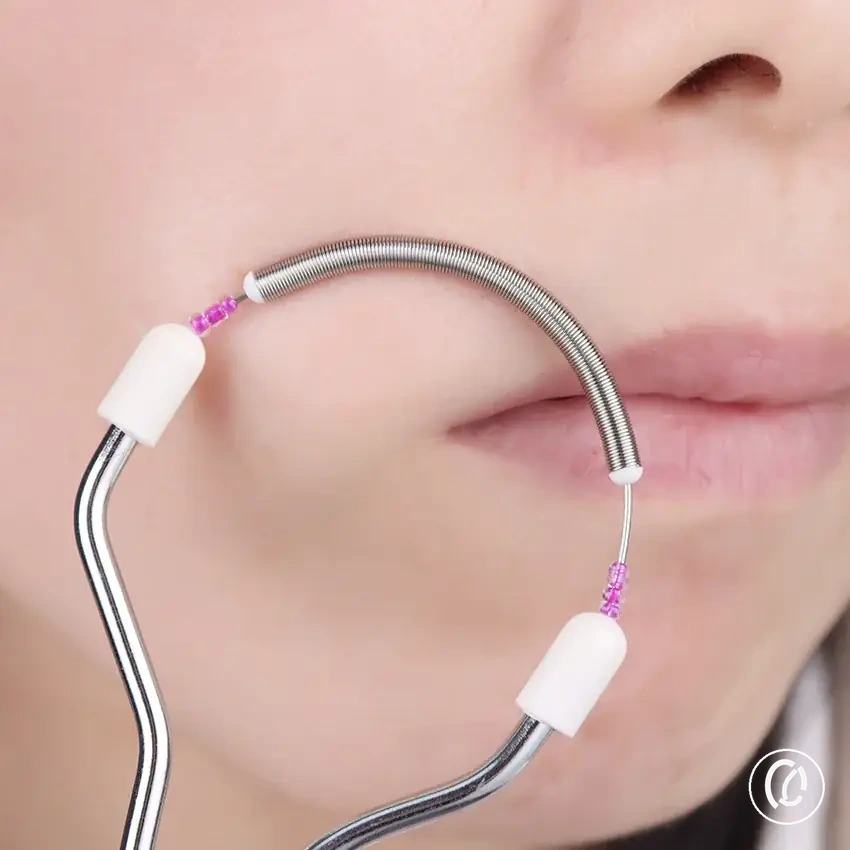
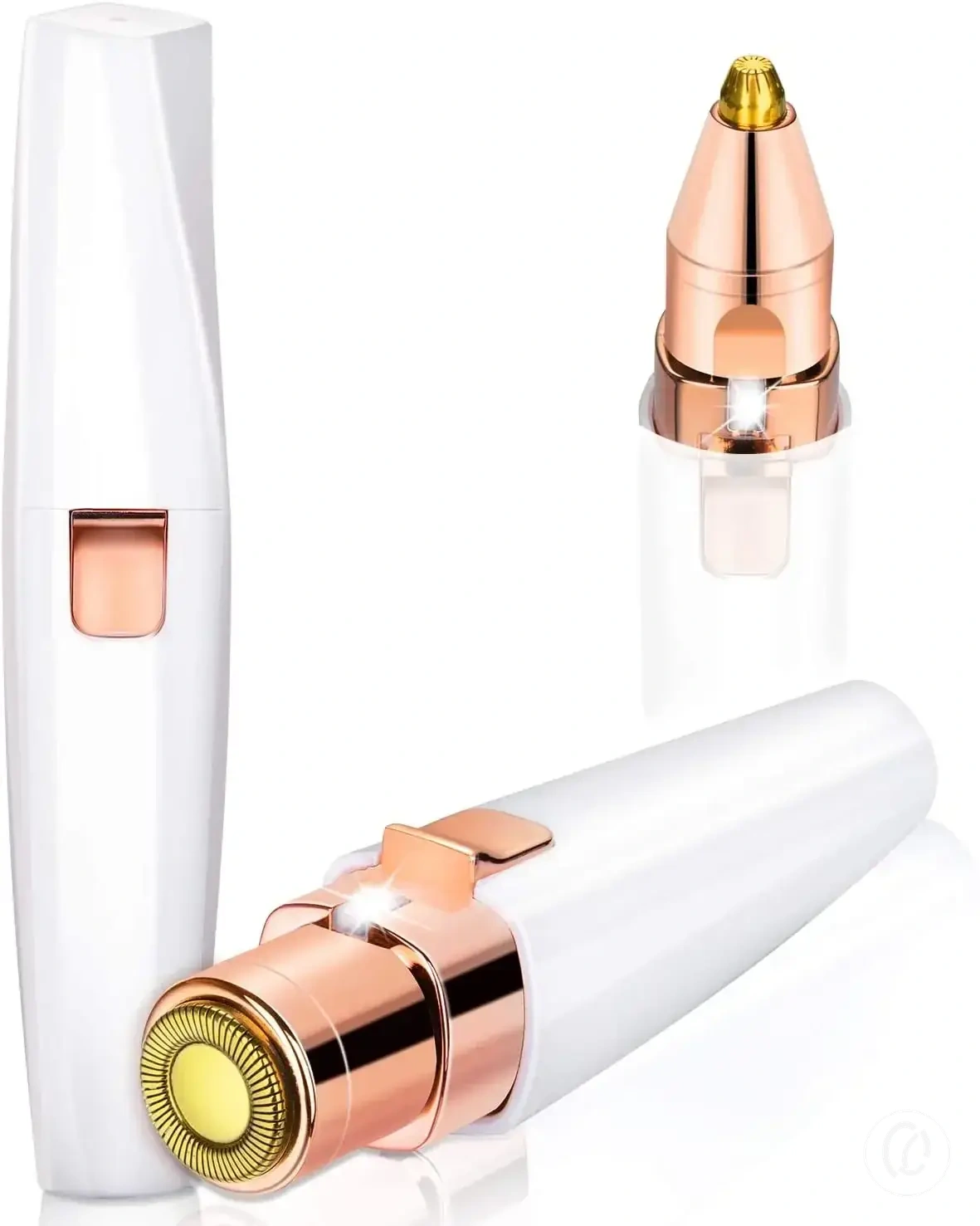
Here are product examples that may make comparison easier.
Here are product examples that may make comparison easier. Before buying, always review the compatibility criteria, essential features, and product details.
This chart shows the four essential matches that a sensitive-skin facial hair remover must satisfy: skin calmness, tool and head fit, and contact part verification.